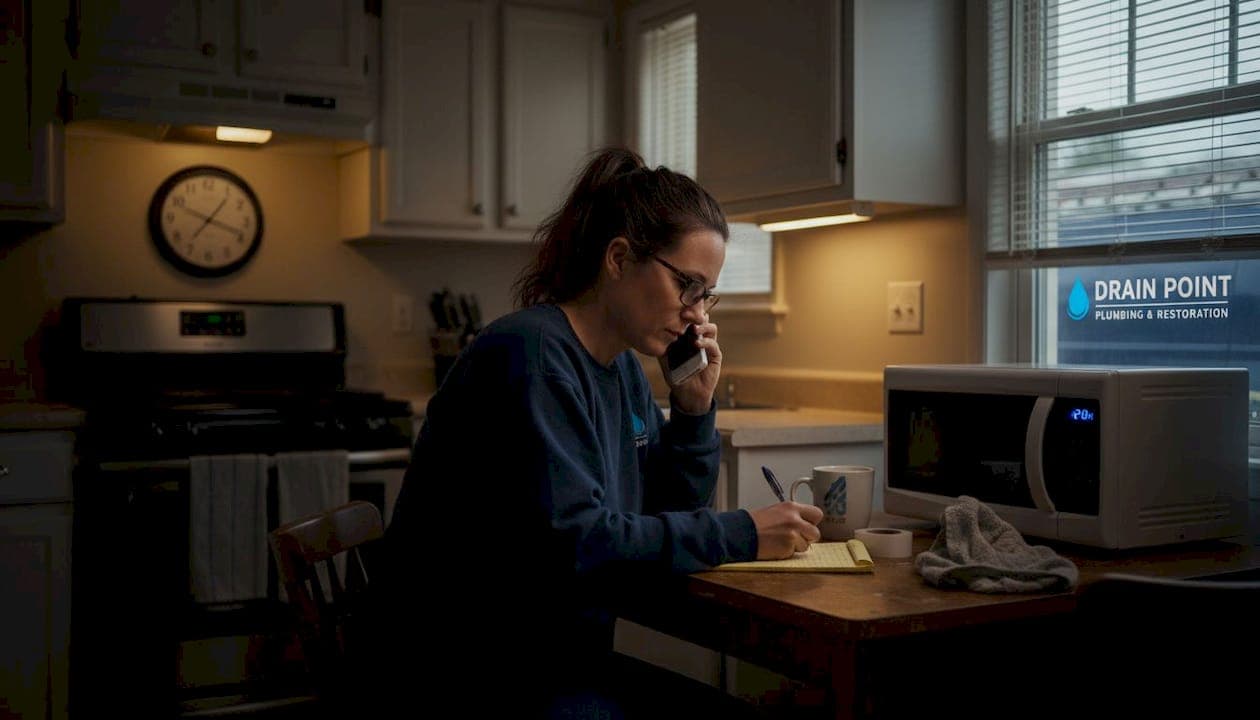
A single missed call during a plumbing emergency can cost you between $500 and $1,500 in preventable property damage. For homeowners and property managers in Santa Maria, that number gets worse fast when flooding, burst pipes, or a sewer backup goes unaddressed for even a few hours. After-hours plumbing dispatch is not just a convenience feature. It is a structured, triage-driven system designed to get the right technician to your door before minor damage becomes a catastrophic and expensive repair. This guide walks you through exactly how that system works, how emergencies get prioritized, and what you can do to improve your response readiness.
Table of Contents
- What happens when you call after-hours
- Emergency vs. urgent: How dispatch teams prioritize
- How technology speeds up after-hours plumbing dispatch
- When things go wrong: Edge cases and property manager solutions
- The truth most property managers miss about after-hours plumbing
- Reliable after-hours plumbing services in Santa Maria
- Frequently asked questions
Key Takeaways
| Point | Details |
|---|---|
| Quick triage matters | Fast call classification ensures urgent plumbing problems get prompt attention. |
| Emergency benchmarks | Expect dispatch within 15 minutes and on-site arrival under an hour for true emergencies. |
| Technology boosts speed | Software and GPS systems help plumbing teams respond faster and keep you updated. |
| Avoid over-dispatch | Dispatching non-emergencies wastes resources and increases costs for property managers. |
| Preventive maintenance saves money | Routine checks and guides reduce after-hours calls and costly repairs. |
What happens when you call after-hours
When a plumbing problem strikes at 2 a.m. on a Saturday, your first question is simple: will anyone actually answer? The answer depends entirely on how your plumber has set up their after-hours system. After-hours plumbing dispatch begins with a live answer, whether that comes from a human dispatcher, a third-party answering service, or an AI-assisted platform that triages the call and routes it to the right technician.
That first point of contact is not just there to take a message. The dispatcher immediately starts gathering information to understand how serious the situation is. The triage questions typically cover the nature of the problem, whether the water or gas has been shut off, whether active leaking or flooding is happening, whether there is any danger to people or property, and whether you have access to a shutoff valve. Every answer shapes what happens next.
Here is a step-by-step look at how a typical after-hours call flows:
- Call is received by a live dispatcher, answering service, or AI system
- Triage questions are asked to determine severity and risk
- Classification places the issue into a priority tier
- Technician is alerted based on classification and location
- Customer receives confirmation via SMS or phone with an estimated arrival time
- Documentation is created so the technician arrives with full context
"The first few minutes of an after-hours call determine everything. A well-trained dispatcher or smart AI system can be the difference between a $300 repair and a $15,000 flood restoration."
Once your issue is classified, you can request emergency plumbing help directly through a provider that has live dispatch coverage around the clock. Getting that call in quickly is always better than waiting.
Emergency vs. urgent: How dispatch teams prioritize
Not every call at midnight is a true emergency, and dispatch teams rely on a tiered classification system to allocate resources fairly and effectively. Understanding these tiers helps you communicate more clearly when you call and know what kind of response to expect.
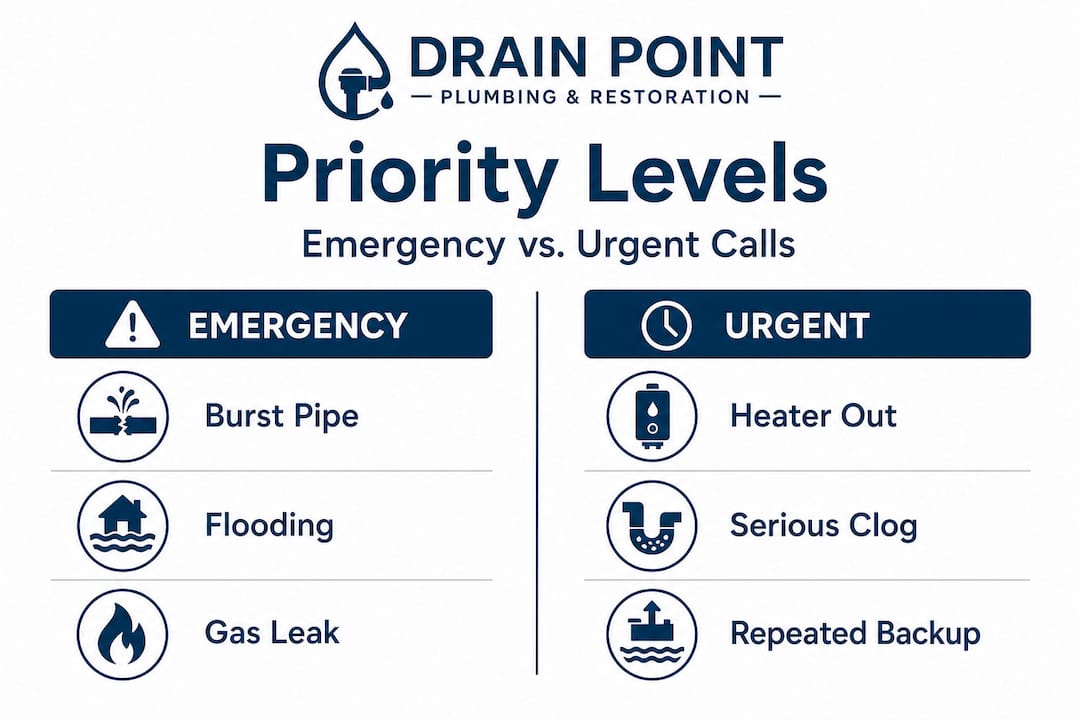
Tier 1 emergencies require immediate action. Think burst pipes with active flooding, raw sewage backup into the home, gas leaks, or a broken water main. These require dispatch within 15 to 60 minutes and represent genuine safety and structural threats. Waiting even an hour on a Tier 1 issue can mean the difference between replacing drywall and replacing an entire subfloor.
Tier 2 urgent calls are serious but stable. A water heater that completely failed, a toilet that backs up repeatedly, or a slow drain that has stopped working entirely. These are addressed within 24 hours and still warrant priority scheduling over routine work.
Routine calls cover maintenance issues, minor leaks under sinks, and non-critical upgrades. These get scheduled during normal business hours.
Here is a side-by-side comparison to help you quickly identify where your situation falls:
| Category | Examples | Response time |
|---|---|---|
| Tier 1 emergency | Burst pipe, flooding, gas leak, sewage backup | Dispatch within 15 min, on-site 45 to 60 min |
| Tier 2 urgent | Water heater failure, persistent backup | Within 24 hours |
| Routine | Dripping faucet, slow drain, minor leak | Scheduled during business hours |
Response benchmarks set on-site arrival for Tier 1 calls at 45 to 60 minutes in city areas and up to 75 minutes for outlying neighborhoods. The industry standard for true emergencies is one hour or less.
Key factors that affect your tier classification include:
- Active flooding versus contained moisture
- Structural or electrical risk from water intrusion
- Gas odor or suspected leak anywhere in the building
- Sewage contact with living spaces
- Number of units affected for property managers
If you are unsure whether your situation qualifies as a Tier 1 emergency, describing the problem clearly to the dispatcher will help them make the right call. Providers offering emergency plumbing services in Santa Maria are trained to walk you through the classification process quickly. For situations where flooding has already occurred, connecting with property restoration experts alongside your plumber ensures that water damage gets addressed at the same time.
How technology speeds up after-hours plumbing dispatch
Once a call is prioritized, modern dispatch systems use technology to ensure fast response. Here is how that works.
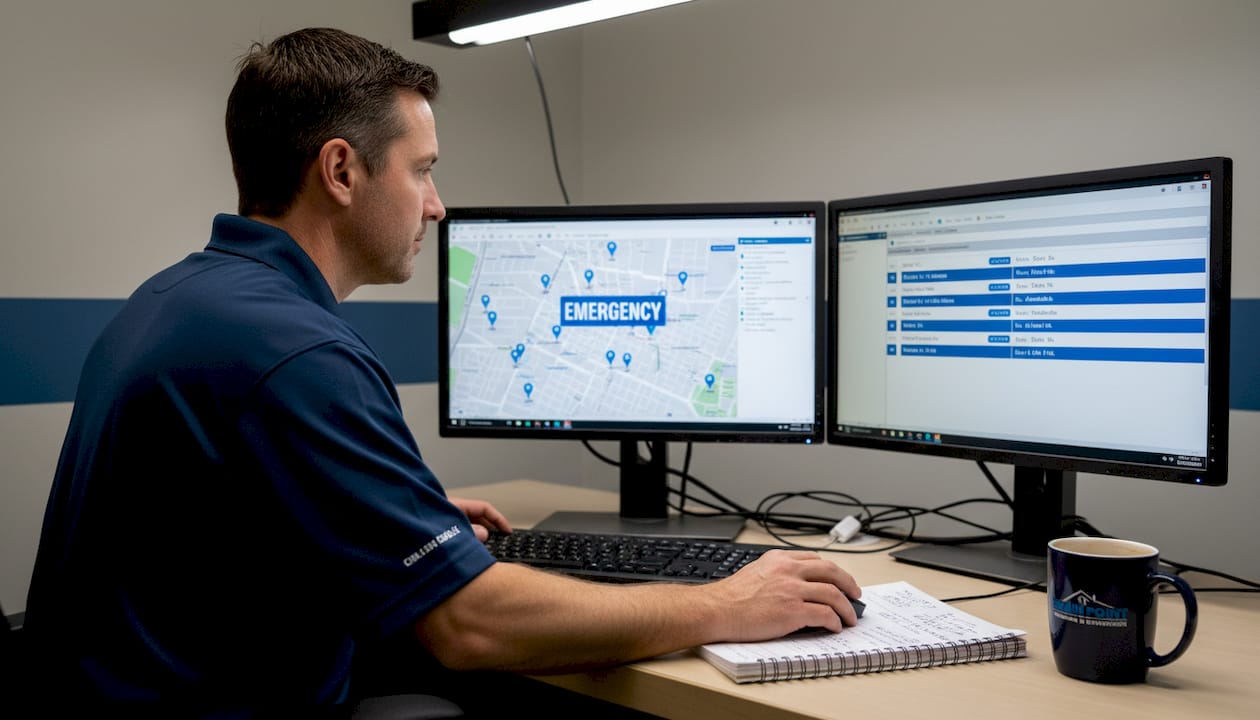
For Tier 1 calls, the process kicks into high gear immediately. The dispatcher or system directly transfers to the on-call technician via cell phone, with automatic escalation to a backup tech if there is no answer within a set time. At the same time, SMS and push notifications are sent to the technician with full job details. An automated work order is created in the system so the tech has the job address, problem type, and any safety notes before they even leave their driveway. The customer also receives an SMS confirmation with the technician's name and estimated arrival window.
GPS is the other major piece of the puzzle. Dispatch software identifies the nearest available technician in real time, cutting down drive time significantly. Instead of a dispatcher manually calling through a list, the system does that matching in seconds.
Here is a comparison of traditional versus technology-assisted dispatch:
| Process | Traditional dispatch | Technology-assisted dispatch |
|---|---|---|
| Technician assignment | Manual phone calls | GPS auto-match to nearest tech |
| Work order creation | Paper or manual entry | Automatic at call classification |
| Customer updates | Follow-up call if remembered | Auto SMS confirmation sent instantly |
| Response time | Variable, 90 to 120 min average | 45 to 60 min average |
| Escalation if no answer | Manual callback | Auto-escalation to backup tech |
Pro Tip: When you call after-hours, ask the dispatcher if they have GPS tracking for their technicians. A provider using modern dispatch software can usually give you a tighter arrival window and even send you a real-time update.
The impact of these systems is not trivial. Software reduces response times by roughly 30% compared to manual coordination, thanks to GPS matching and automation. That half-hour difference matters enormously when water is spreading across your floors.
For homeowners in Santa Maria, scheduling preventive plumbing maintenance through tools like sewer camera inspections also reduces the odds of landing in an after-hours emergency in the first place.
When things go wrong: Edge cases and property manager solutions
While most dispatches run smoothly, there are times when things do not go as planned. Here is what you need to know.
Over-dispatching is a real problem in poorly managed systems. When non-emergencies get flagged as Tier 1 calls, it pulls technicians away from genuine crises and leads to exhaustion and higher operational costs. Over-dispatching non-emergencies causes technician burnout and unnecessary costs, while under-responding to true emergencies risks safety and serious revenue loss. Well-configured AI filters and experienced dispatchers help prevent both problems.
Weather delays are another challenge. During heavy storms or severe weather events in Santa Barbara County, response times can stretch by 2 to 4 hours even for Tier 1 calls. This is not negligence. It reflects road conditions, flooding, and simultaneous call surges. Knowing this in advance helps you set realistic expectations.
For property managers specifically, the challenge is bigger. You may be responsible for dozens of units, multiple tenants calling at once, and varying degrees of emergency severity. Here are the most effective tools and strategies for managing after-hours plumbing from the property manager side:
- Pre-vetted vendor networks: Maintain a list of licensed plumbers and vendor repair networks you have vetted in advance, with after-hours coverage confirmed
- Tenant emergency guides: Distribute simple one-page guides with shutoff valve locations and instructions for each unit. Tenants who shut off the water immediately can prevent the situation from worsening while you wait for dispatch
- 24/7 answering systems: Use a dedicated answering service or AI platform so tenant calls are always received, triaged, and logged even when you are asleep
- Documentation protocols: Require all after-hours calls to generate a written record, including timestamp, description, and dispatch confirmation. This protects you legally and helps you track recurring issues
- Clear emergency definitions: Pre-vetted vendor networks and tenant emergency guides are most effective when paired with a written policy that clearly distinguishes true emergencies like active leaks and sewer backups from non-urgent issues like a slow-draining sink or a dripping faucet
Pro Tip: Give every tenant a laminated card with the water shutoff location and your after-hours emergency line. When a pipe bursts at 3 a.m., a tenant who can cut the water supply immediately is your best first line of defense.
Proactive property managers who invest in these systems spend far less on emergency repairs over time, because problems are caught earlier, handled faster, and documented properly from the start.
The truth most property managers miss about after-hours plumbing
Here is the uncomfortable reality: most emergency plumbing calls are not really emergencies. They are the result of deferred maintenance, ignored warning signs, and systems that were overdue for inspection. After nearly two decades working in Santa Maria plumbing and restoration, we have seen this pattern repeat itself endlessly.
Homeowners and property managers often focus all their energy on building a good emergency response plan. That makes sense. But the better investment is in preventing the emergency in the first place. Preventive maintenance reduces calls, and software cuts response times by 30% through GPS and automation. But no amount of dispatch technology makes up for a corroded pipe that should have been replaced two years ago.
The hidden value of AI dispatch systems is real. They filter calls effectively, route technicians faster, and provide consistent documentation. But AI has a ceiling. When a situation involves complex triage, such as a gas leak combined with flooding, or a sewer backup affecting multiple units, you need an experienced human dispatcher who can make judgment calls and coordinate multiple trades at once.
The cost difference between fast and slow response is also dramatic. Immediate dispatch prevents escalation from a $2,000 repair to $15,000 or more in property damage. That number alone should motivate every property manager to build a real emergency plan, not just assume a plumber will show up quickly.
Our honest advice: invest in scheduled plumbing inspections twice a year. Know where your shutoff valves are. Have your vendor network set up before you need it. And choose a plumbing provider you have already called before you are in crisis mode, not during one.
Reliable after-hours plumbing services in Santa Maria
If you are ready to improve your emergency readiness, here is how to connect with reliable local plumbers in Santa Maria.
Drain Point Plumbing & Restoration is a locally owned emergency plumbing contractor serving homeowners and property managers across Santa Barbara County. With over 15 years of experience and 24/7 availability, we handle Tier 1 emergencies with the response times the job demands. Our team uses GPS-enabled dispatch, automated work orders, and real-time communication so you always know when help is arriving.
Whether you need a burst pipe repaired at midnight, flood restoration the next morning, or a scheduled sewer camera inspection to prevent the next emergency, we have the team and tools to handle it. You can request a plumbing quote at any time, around the clock, with no waiting until business hours. For water, fire, or mold damage following an emergency, our restoration experts are fully equipped to bring your property back to safe condition. Santa Maria residents also qualify for senior and military discounts on all services.
Frequently asked questions
What qualifies as an emergency plumbing issue after-hours?
True emergencies include burst pipes, active flooding, gas leaks, major backups, and any active leak that threatens safety, electrical systems, or significant property damage. These are classified as Tier 1 and require immediate dispatch.
How quickly can an after-hours plumber arrive?
Industry benchmarks set on-site arrival at 45 to 60 minutes for city areas and up to 75 minutes for outlying areas when the call is classified as a Tier 1 emergency, with dispatch initiated within 15 minutes of the call.
Do plumbers use software or GPS to speed up emergency dispatch?
Yes. Modern dispatch software uses GPS to automatically assign the nearest available technician, integrates with CRM platforms for work order creation, and provides real-time tracking to reduce response times significantly.
Can weather delays affect after-hours plumbing response?
Severe storms and extreme weather can extend response times by 2 to 4 hours even for Tier 1 emergencies, due to road conditions, flooding, and high simultaneous call volume. Always notify dispatch immediately so your call is logged and queued.
What should property managers do before calling after-hours?
Follow tenant guide shutoff instructions to stop active water flow, assess whether the situation is a true emergency or urgent issue, and have your pre-vetted vendor documentation ready before you dial so dispatch gets the full picture immediately.
Recommended
- Contact Us - Drain Point Plumbing & Restoration
- Full-Service Residential Plumbing Repairs & Fixture Replacements Santa Maria CA - Drain Point Plumbing & Restoration
- Local Plumbing Contractor, Emergency Residential Plumbing Services Santa Maria CA - Drain Point Plumbing & Restoration
- Sewer Repair & Drain Cleaning Services Santa Maria CA - Drain Point Plumbing & Restoration