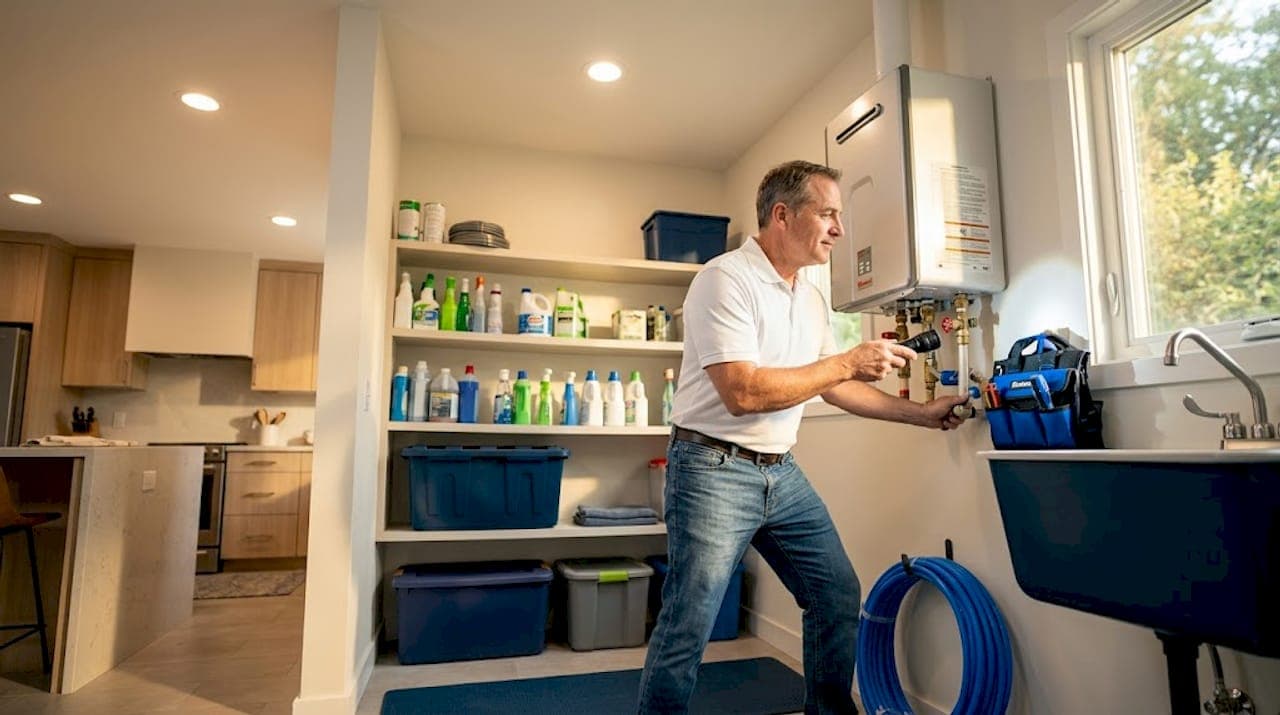
Most homeowners assume "tankless" means instant hot water at the tap, all day, without limits. That's not quite right. The tankless water heater explained properly is a picture of real efficiency gains, real trade-offs, and a technology that works best for some households and poorly for others. If you're deciding whether to upgrade or replace your current system, you need the full story. This article breaks down how the technology works, what it actually costs, and whether it fits your home and lifestyle.
Table of Contents
- Key takeaways
- How tankless water heaters work
- Energy efficiency and cost considerations
- Benefits and drawbacks: a real-world look
- Installation considerations for homeowners and renters
- Keeping it running: tankless water heater maintenance
- My honest take after 15+ years of water heater calls
- Ready to make the switch? Drainpointplumbing can help
- FAQ
Key takeaways
| Point | Details |
|---|---|
| Not truly instant | Heated water still travels through pipes, so you'll wait a few seconds depending on fixture distance. |
| Real efficiency gains | Tankless units are 24-34% more efficient for low-usage homes, primarily by eliminating standby heat loss. |
| Higher upfront cost | Expect to pay more to install a tankless system, but the unit can last over 20 years. |
| Maintenance is non-negotiable | Annual flushing and scale prevention are required to protect efficiency and extend lifespan. |
| Sizing matters most | The wrong size unit, or too few units for a large household, kills performance fast. |
How tankless water heaters work
When you turn on a hot water tap, cold water flows into the unit and triggers a flow sensor. That sensor activates a heat exchanger, which rapidly transfers heat from a gas burner or electric element directly to the passing water. There's no stored tank of preheated water. The water heats as it moves through the system and arrives at your tap warm.
The key phrase there is "as it moves through." This is where the "instant hot water" myth comes undone. The unit heats the water immediately, but the already-cold water sitting in the pipes between the heater and your faucet still has to clear first. In a large home, that can take 30 to 60 seconds. It's not a flaw in the technology. It's just physics.
Gas vs. electric models
The fuel type you choose has a direct impact on performance. Gas-fired units, whether natural gas or propane, produce higher flow rates than their electric counterparts. According to the Department of Energy, gas units deliver 2-5 gallons per minute, which is enough for most households running one or two fixtures simultaneously. Electric models tend to cost less upfront and require less complex installation, but they struggle in cold climates where incoming water is significantly colder and requires more energy to heat.
Here's what controls your experience day to day:
- Flow rate capacity: Measured in gallons per minute (GPM), this determines how many fixtures can run hot simultaneously.
- Temperature rise needed: The colder your incoming groundwater, the harder the unit works.
- Activation delay: There's a brief lag between turning on the tap and triggering the heat exchanger.
- Fuel availability: Gas units need a gas line; electric units need adequate panel capacity.
Pro Tip: If your home sits in a colder region, look for a gas unit with a higher BTU rating. Electric models in cold climates often struggle to reach the target output temperature at full flow.
Energy efficiency and cost considerations
This is where tankless systems make their strongest argument. Traditional tank heaters keep 40 to 80 gallons of water hot around the clock, even when no one is home. That constant reheating, called standby heat loss, accounts for up to 30% of your total water heating costs. Tankless units eliminate that waste entirely because they only fire up when you need hot water.
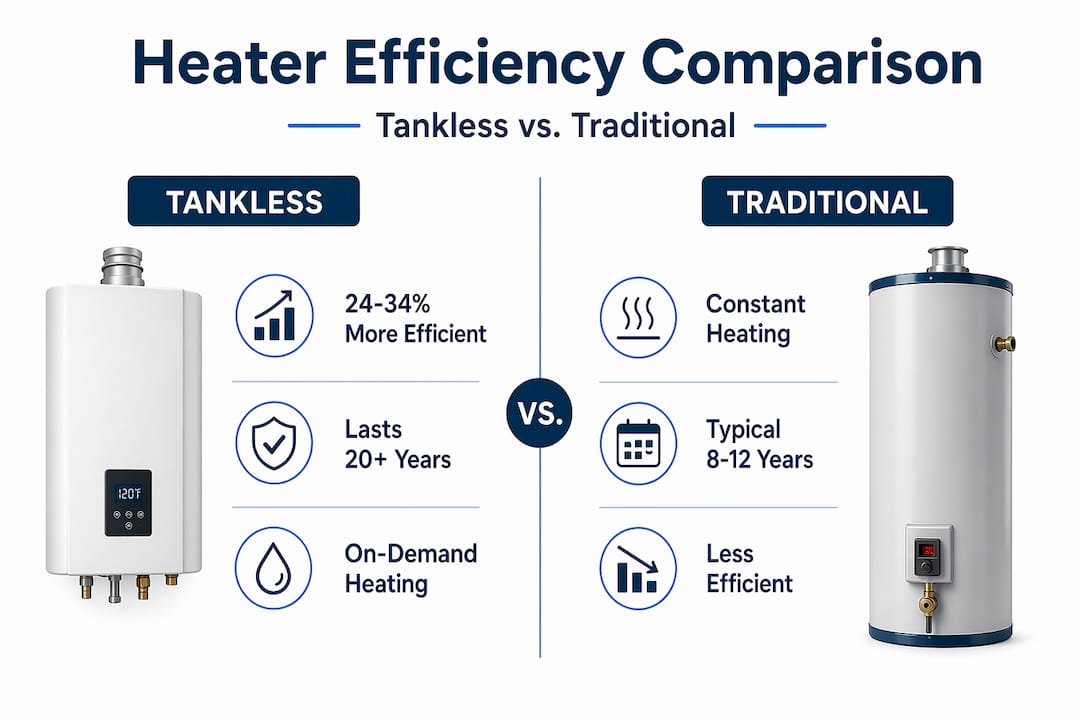
The efficiency gains are real, but they're scaled to how much hot water your household uses.
| Daily Hot Water Use | Efficiency Advantage |
|---|---|
| 41 gallons or less | 24-34% more efficient than a storage tank |
| Around 86 gallons | 8-14% more efficient than a storage tank |
| Very high usage | Marginal gains; multiple units may be needed |
On the cost side, you need to look at two numbers: upfront installation and long-term operational savings. Tankless installations typically cost between $1,000 and $6,000, compared to $1,200 to $4,500 for traditional tank replacements. The upper end of that tankless range reflects gas line upgrades, new venting, and electrical work. That gap is real.
What offsets it is lifespan. Tankless units last over 20 years, while traditional tanks typically top out at 8 to 12 years. Over a 20-year window, you're likely replacing a traditional tank at least once, if not twice. Factor in lower monthly energy bills, and the long-term math often favors going tankless.
Pro Tip: Ask your utility company if they offer rebates for switching to a high-efficiency tankless water heater. Many California utilities do, and it can meaningfully reduce your net installation cost.
Benefits and drawbacks: a real-world look
No system is perfect. Tankless water heaters have genuine advantages, but they come with trade-offs that trip up homeowners who weren't expecting them.
What they do well
- Space savings: Most tankless units mount to a wall and take up a fraction of the space a 50-gallon tank requires.
- Continuous supply: You won't run out of hot water mid-shower the way you would with a drained tank.
- Lower long-term energy waste: No standby heat loss means your utility bill doesn't pay for water that sat hot for 8 hours while you were at work.
- Longer lifespan: With proper maintenance, tankless units exceed 20 years of service life.
Where they fall short
| Challenge | What It Means for You |
|---|---|
| Flow rate limits | Running a shower and dishwasher simultaneously may exceed the unit's GPM capacity. |
| Cold water sandwich | A burst of cold water between hot draws can happen in sequential short uses. |
| Higher install cost | Gas line work, venting, and permits push costs well above a simple tank swap. |
| Complex troubleshooting | Error codes and flame sensors require a professional; DIY fixes are rarely simple. |
For large households, multiple units or hybrid setups are sometimes the right solution. Two smaller tankless units, or one tankless paired with a small point-of-use unit near the kitchen, can address flow rate limits without oversizing a single unit.
Installation considerations for homeowners and renters
Installing a tankless water heater is not like swapping out a tank. It often triggers a chain of related upgrades that affect your home's infrastructure. Here's what to work through before committing:
- Fuel source and gas line capacity: Gas tankless units typically need a larger gas supply line than older tank heaters. Your existing line may require upgrading.
- Venting requirements: Most gas units need dedicated exhaust venting, either direct vent or power vent systems. Running new vent pipes adds labor and materials to your project cost.
- Electrical panel demands: Electric tankless units draw significant amperage. Older homes with 100-amp panels often require a panel upgrade before installation can happen.
- Proper sizing: Flow rate needs vary by household. Professional sizing and installation prevent the most common failure: a unit too small to meet peak demand.
- Permits and local codes: Most jurisdictions require permits for water heater replacements. Skipping this step creates problems when you sell the home.
- Renter challenges: If you rent, you need landlord approval for any water heater replacement. Even if the landlord agrees, the infrastructure work often falls to the property owner, not the tenant.
The installation question is one area where cutting corners costs more in the long run. A unit that's slightly undersized, or connected to an undersized gas line, will underperform from day one and develop problems faster than it should.
Keeping it running: tankless water heater maintenance
A tankless unit that's never serviced will not last 20 years. The efficiency gains you're counting on depend on the heat exchanger staying clean and the water flow staying unobstructed. That requires regular attention.
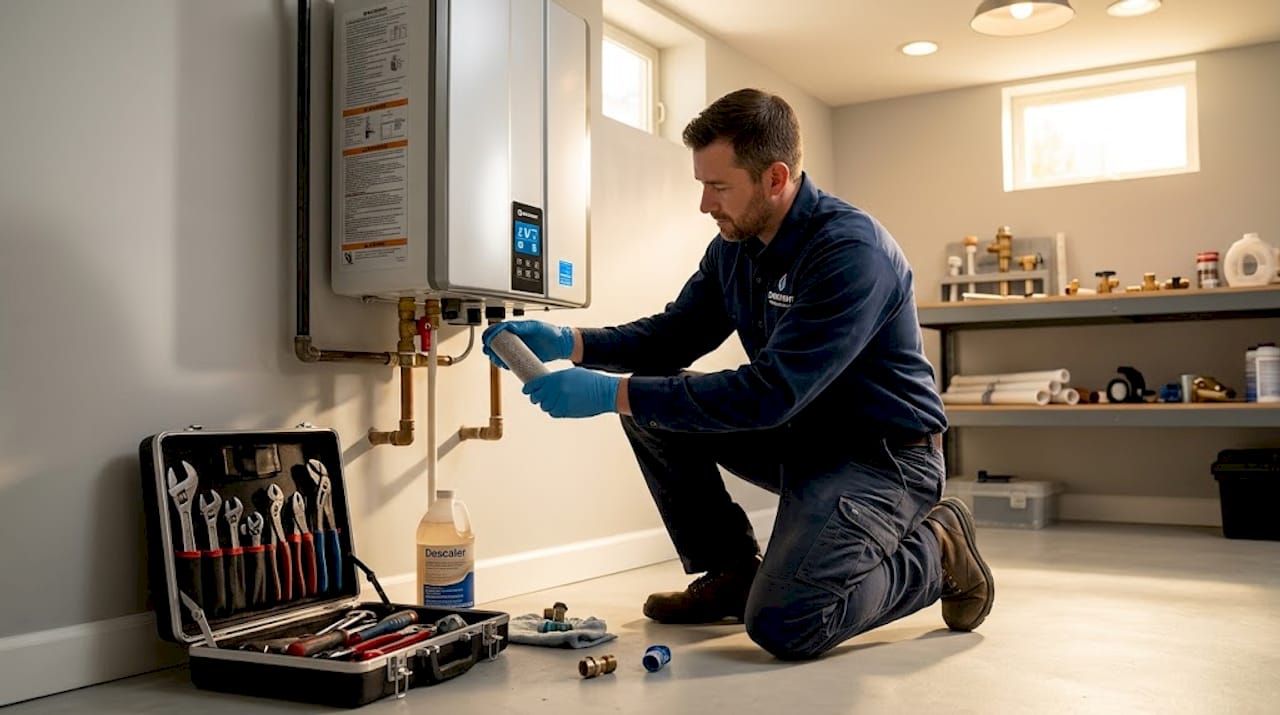
Periodic flushing and anode rod replacement are the two most critical maintenance tasks. In areas with hard water, like much of California's Central Coast, scale builds up inside the heat exchanger over time. That scale acts as insulation, making the unit work harder to achieve the same output. Left unchecked, it permanently damages the exchanger.
Here's the standard maintenance checklist for tankless units:
- Annual flush: Run a descaling solution through the unit to dissolve mineral buildup in the heat exchanger.
- Inlet filter cleaning: Most units have a small screen filter at the cold water inlet. Clean it every 6 to 12 months.
- Venting inspection: Check exhaust venting for blockages or corrosion, especially after the first year.
- Professional check: Have a licensed plumber inspect the unit, burner assembly, and connections every two to three years.
- Water softener consideration: If you live in a hard water area, proper installation and maintenance may include a water softener upstream of the heater to reduce scale dramatically.
Pro Tip: Schedule your annual flush in the fall before cold-weather demand peaks. It's the best time to catch issues before your household is relying on the unit most.
My honest take after 15+ years of water heater calls
People ask me all the time whether they should go tankless, and my first question back is always: "How many people live in your home, and when does everyone shower?" That question tells me more than any spec sheet.
I've seen families of four install a single undersized gas unit because it looked good on paper, then call me six months later frustrated that they're running out of capacity every morning. And I've seen couples in small homes switch to tankless and genuinely cut their energy bills noticeably over a year. Both outcomes are predictable if you do the homework upfront.
The upfront cost concern is real. I don't dismiss it. But when I show someone that they're likely replacing a traditional tank twice in the time a tankless unit runs, the math shifts. What I tell people: don't buy the cheapest unit and assume the cheapest installation. The savings come from a correctly sized, properly installed, and regularly maintained system. Shortcut any one of those three things, and you're just buying an expensive headache.
If you're a renter, be realistic. Unless your landlord is already planning a replacement, this probably isn't your decision to make. But if you own your home and plan to stay for more than 10 years, a tankless system is worth a serious look.
— Kirk
Ready to make the switch? Drainpointplumbing can help
Deciding to go tankless is one thing. Getting the installation right is another entirely.
At Drainpointplumbing, we've handled water heater installations and repairs across Santa Maria and Santa Barbara County for over 15 years. We size units correctly for your household demand, handle gas line upgrades and venting, pull the required permits, and make sure your new system runs efficiently from day one. If you're not sure whether tankless is right for your home, we'll give you an honest answer before we recommend anything. We also offer residential plumbing upgrades for the infrastructure work that often comes with a tankless installation. Request a free quote and get a clear picture of what the project actually involves.
FAQ
How does a tankless water heater work?
Cold water flows into the unit, activates a heat exchanger via a flow sensor, and exits hot on demand. There's no storage tank; the water heats only when you need it.
Do tankless water heaters really save money?
Yes, but the amount depends on your usage. Homes using 41 gallons or less daily see 24-34% efficiency gains over traditional tanks, with savings growing over the unit's 20-plus year lifespan.
What is the cold water sandwich effect?
It's a short burst of cold water between two hot draws that happens when residual hot water in the pipes is followed by unheated water. It's common with tankless units during short, back-to-back uses.
Can a renter install a tankless water heater?
Generally no. Replacing a water heater requires landlord approval and often involves infrastructure changes like gas line or electrical work that are the property owner's responsibility.
How often does a tankless water heater need maintenance?
Plan on an annual descaling flush, inlet filter cleaning every 6 to 12 months, and a professional inspection every two to three years to keep the unit running at full efficiency.
Recommended
- Water Heater Installation And Repair Santa Maria CA - Drain Point Plumbing & Restoration
- Water Filtration Systems Installation Santa Maria CA - Drain Point Plumbing & Restoration
- Full-Service Residential Plumbing Repairs & Fixture Replacements Santa Maria CA - Drain Point Plumbing & Restoration
- Local Plumbing Contractor, Emergency Residential Plumbing Services Santa Maria CA - Drain Point Plumbing & Restoration