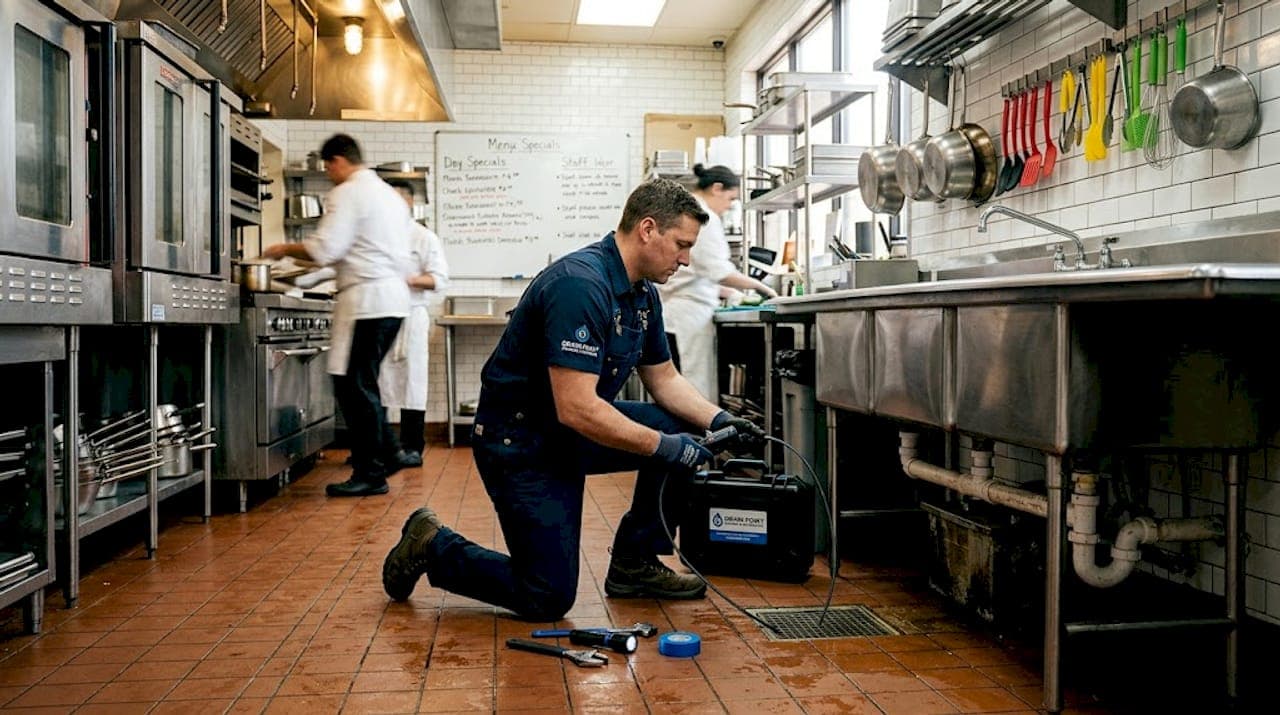
Most commercial property managers assume a bottle of drain cleaner handles whatever builds up in the pipes. It does not. Understanding how commercial drain maintenance prevents clogs requires looking past the quick fix and recognizing what actually accumulates in a commercial drainage system over time. Neglect compounds. What starts as a slow drain becomes a backup, and a backup becomes an emergency repair that shuts down operations. The cost difference between proactive maintenance and reactive repairs is not trivial — it is the difference between a scheduled service call and a flooded kitchen on a Friday night.
Table of Contents
- Key takeaways
- How commercial drain maintenance prevents clogs at the source
- Practical strategies for preventing drain blockages
- Comparing drain cleaning methods
- Business impact of consistent drain upkeep
- My take on what commercial drain maintenance gets wrong
- Get professional drain maintenance from Drainpointplumbing
- FAQ
Key takeaways
| Point | Details |
|---|---|
| FOG is the primary culprit | Fats, oils, and grease coat pipe walls and trap solids, making regular interception mandatory. |
| The 25% rule drives pump-out timing | Grease traps must be serviced before reaching 25% combined FOG and solids capacity to prevent bypass. |
| Chemicals alone are not enough | Repeated chemical treatments fail to remove deep buildup and can damage pipe walls over time. |
| Hydro-jetting outperforms snaking | High-pressure water cleaning removes entire buildup layers, not just temporary obstructions. |
| System-wide thinking prevents backups | Treating every connected drain as part of one network avoids isolated fixes that push problems downstream. |
How commercial drain maintenance prevents clogs at the source
Every clog in a commercial drain system has an origin story, and most of them start the same way: fats, oils, and grease, collectively known as FOG. In a commercial kitchen, FOG enters the drainage system constantly through dishwashing, food prep, and cooking. At high temperatures it flows freely. As it cools in the pipes, it solidifies and coats the interior walls of drains, traps, and sewer lines.
Food solids compound the problem. Particles of rice, vegetable matter, coffee grounds, and starch enter the drains alongside hot FOG, and as the grease hardens, those solids get trapped in the coating. Layer by layer, the pipe narrows. Flow slows. Odors develop. Eventually the drain backs up entirely.
This is where the grease interceptor, or grease trap, is supposed to intervene. The trap captures FOG before it reaches the municipal sewer. But the trap only works when it has capacity. Servicing is required before reaching 25% capacity to prevent grease carry-over into the sewer line. Once the trap is overloaded, FOG bypasses the interceptor entirely and the problem migrates downstream.
- FOG cools and solidifies on pipe walls within feet of the drain opening
- Food particles bond to grease deposits and accelerate blockage formation
- Grease trap overflow sends unfiltered FOG directly into the municipal sewer
- Chemical drain cleaners break surface buildup temporarily but cannot dissolve hardened FOG layers deep in the pipe
Pro Tip: Do not wait for a slow drain to tell you the trap needs service. Check fill levels during routine kitchen walkthroughs and log the data so you can spot patterns before they become problems.
The misconception that commercial drain cleaning tips begin and end with a weekly dose of enzyme treatment is exactly what gets property managers into trouble. Enzymatic products slow buildup, but they do not eliminate it. The foundational work happens in person, with real tools and real inspections.
Practical strategies for preventing drain blockages
Knowing what causes clogs is only half the equation. The other half is a concrete maintenance plan that addresses every point in the drainage network, not just the trap that is easiest to reach.
Grease trap management done right
Monitoring actual grease and solids load rather than following a fixed calendar schedule is the single most important shift a commercial property manager can make. A restaurant that runs heavy lunch and dinner services fills its trap faster than one operating limited hours. Scheduling pump-outs every 90 days regardless of actual load is a guess. Scheduling them based on measured fill levels is a system.
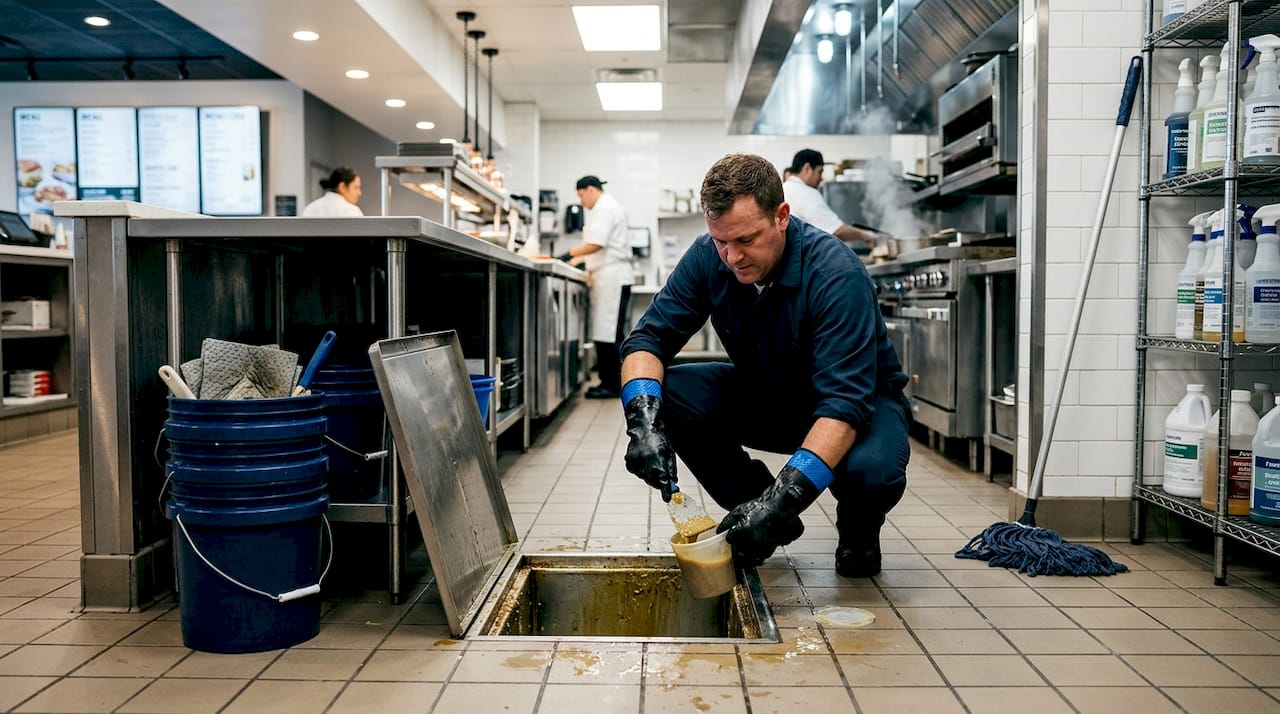
Trap sizing also matters. An undersized interceptor will hit the 25% threshold weekly. If your trap is constantly requiring service, the right answer is not more frequent pump-outs forever. The right answer is evaluating whether the interceptor capacity matches the actual volume of FOG your operation produces.
System-wide preventive maintenance
Treating the drainage waste vent system as a whole reduces widespread clog risks because debris that accumulates in a fixture drain eventually migrates to the building drain and then to the sewer connection. Fixing one clogged floor drain while ignoring the build-up in connected lines is an incomplete solution.
A proper commercial drain maintenance program covers:
- Floor drains in kitchens, restrooms, and utility areas
- Under-sink trap arms and branch lines
- Grease interceptors and lint traps
- Roof drains and area drains if applicable
- The main building drain and cleanout access points
Pro Tip: Map your entire drainage network before scheduling maintenance. A diagram of every fixture, trap, and cleanout access point turns a vague maintenance plan into a specific checklist.
Enzymatic and chemical treatments
Enzymatic treatments introduce bacteria that digest FOG and organic material. They work best as a supplement to mechanical cleaning, not as a replacement. Regular maintenance supports eco-friendly practices by reducing reliance on harsh chemical cleaners, which is a meaningful advantage in municipalities with strict environmental discharge regulations.
Chemical drain cleaners are a different story. Repeated chemical use can damage pipes and fails to address the root causes of buildup, particularly in older cast-iron or clay sewer laterals that many commercial buildings in Santa Barbara County still use.
Comparing drain cleaning methods
Not all cleaning approaches deliver the same results. The method you choose affects how thoroughly the pipe is cleaned, how long the results last, and what the process costs over a full year of operations.
| Method | Best use case | Limitations |
|---|---|---|
| Chemical drain cleaners | Minor surface-level organic buildup | Pipe damage risk with repeated use; does not remove FOG layers |
| Enzymatic treatments | Ongoing maintenance between professional visits | Slow-acting; ineffective against established heavy buildup |
| Drain snaking | Clearing solid obstructions and root intrusions | Punches through clogs but leaves grease on pipe walls |
| Hydro-jetting | Deep cleaning of grease-coated commercial lines | Requires professional equipment; not suitable for fragile pipes |
| Camera inspection | Diagnosing cause and location of blockage | Diagnostic only; must be paired with a cleaning method |
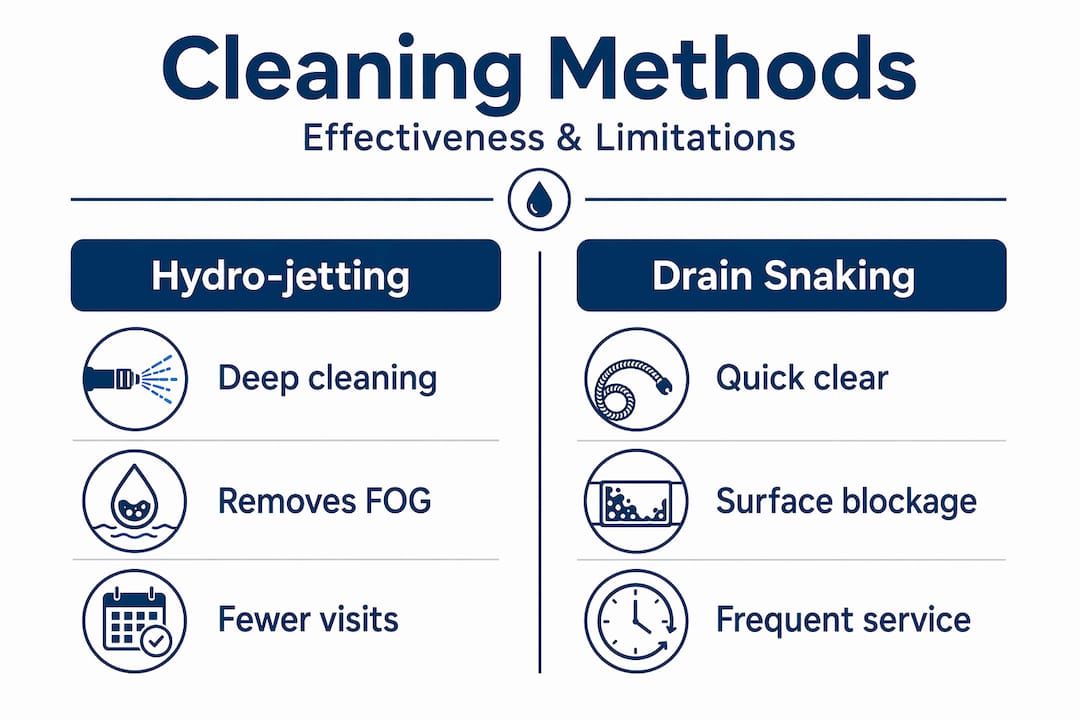
Hydro-jetting removes entire buildup layers rather than just piercing a clog, which is what makes it the preferred method for commercial kitchen lines. A drain snake opens a temporary path through a clog. Hydro-jetting scours the pipe wall and restores close-to-original diameter flow. The difference shows up in how long it takes before the line needs service again.
Understanding what drain snaking is and when it applies helps you have smarter conversations with your plumber. Snaking is the right tool when a solid object is blocking the line. It is the wrong tool when years of grease coating have reduced a four-inch drain to a two-inch effective opening.
Pipe material also factors into method selection. High-pressure hydro-jetting requires professional judgment about PSI settings, particularly in older or rehabilitated pipe sections. A sewer camera inspection before cleaning tells you exactly what you are working with.
Business impact of consistent drain upkeep
The business case for how to maintain drains proactively comes down to three categories: operational continuity, cost control, and regulatory standing.
-
Operational continuity. Slow drainage and odors disrupt operations and harm customer experience directly. A restaurant with a backed-up floor drain or a hotel with a sewage odor in a guest corridor faces immediate revenue consequences. A scheduled maintenance visit costs a fraction of what a mid-service shutdown costs.
-
Cost control. Regular commercial drain cleaning avoids costly pipe damage that accumulates when grease-laden water sits against pipe walls. Emergency plumbing calls carry premium labor rates, and if a pipe section fails, you are looking at excavation and replacement, not a simple service visit. If neglect reaches the point of property damage, the cost escalates further into water damage restoration territory.
-
Regulatory compliance. Many California municipalities enforce FOG ordinances that require commercial food service operators to maintain properly functioning grease interceptors. Failing an inspection because your trap is overloaded can result in fines or even a temporary closure order.
Pro Tip: Build drain maintenance into your annual facilities budget as a fixed line item, not an on-call expense. Predictable spending is always cheaper than emergency spending.
High-pressure hydro-jetting significantly reduces future maintenance frequency, which means a single thorough cleaning can extend the interval between service visits. Over a 12-month cycle, the math usually favors one hydro-jet service over three or four drain snake visits that never fully address the underlying buildup.
My take on what commercial drain maintenance gets wrong
I have seen the same pattern more times than I can count. A property manager calls because they have a persistent backup problem. We come out, clear it, and ask about their maintenance history. The answer is almost always the same: they pour enzyme treatment down the drains every couple of weeks and figured that was enough.
What bothers me about that approach is not the enzyme treatment itself. Enzymatic products have a real role in slowing buildup between professional visits. The problem is treating them as a complete solution. In my experience, the managers who have the worst clog problems are almost never the ones doing nothing. They are the ones doing just enough to feel like the situation is under control.
The other thing I would push back on hard is the fixed-schedule trap service. I have watched operators pump out a grease trap that was barely at 10% capacity, then neglect the same trap until it overflowed two months later during a high-volume event week. Monitoring actual load levels is not complicated. It requires a logbook and a measuring tool, not specialized equipment. But it does require someone to treat it like a real responsibility rather than a checkbox.
What I have found actually works is treating the entire drainage network as one system. When you look at it that way, every floor drain, every trap arm, every cleanout is a data point. Repeated clogs in the same location tell you something about the pipe upstream or downstream. Address the pattern, not just the symptom.
— Kirk
Get professional drain maintenance from Drainpointplumbing
If your commercial property is in Santa Barbara County and you are tired of managing drain problems reactively, Drainpointplumbing is ready to help you build a maintenance program that actually holds. With over 15 years of experience, the team uses advanced camera inspection technology and hydro-jetting to thoroughly clean and assess commercial drainage systems before small problems become expensive emergencies. Whether you need a one-time deep clean or a scheduled maintenance agreement, the process starts with a clear picture of what is actually happening inside your pipes. Request a free maintenance quote or explore professional drain cleaning services to schedule your first inspection today.
FAQ
What causes most commercial drain clogs?
Fats, oils, and grease are the primary cause of clogs in commercial drains. FOG coats pipe walls as it cools, trapping food solids and progressively narrowing the pipe until flow stops.
How often should a commercial grease trap be serviced?
Service frequency should be based on actual fill levels, not a fixed schedule. Grease traps require service before reaching 25% combined FOG and solids capacity to prevent bypass into the sewer line.
Is hydro-jetting better than drain snaking for commercial pipes?
Yes, for grease-coated commercial lines. Hydro-jetting powers through grease and sludge and removes entire buildup layers, while snaking only clears a path through the obstruction without cleaning the pipe walls.
Can chemical drain cleaners replace professional cleaning?
No. Repeated chemical use damages pipe walls and does not remove established FOG deposits. Professional cleaning provides thorough buildup removal that chemicals cannot replicate.
How does drain maintenance affect regulatory compliance?
California municipalities enforce FOG ordinances requiring functional grease interceptors in commercial food service operations. Regular professional drain maintenance and grease trap management keeps you within compliance and avoids fines or closure orders from failed inspections.