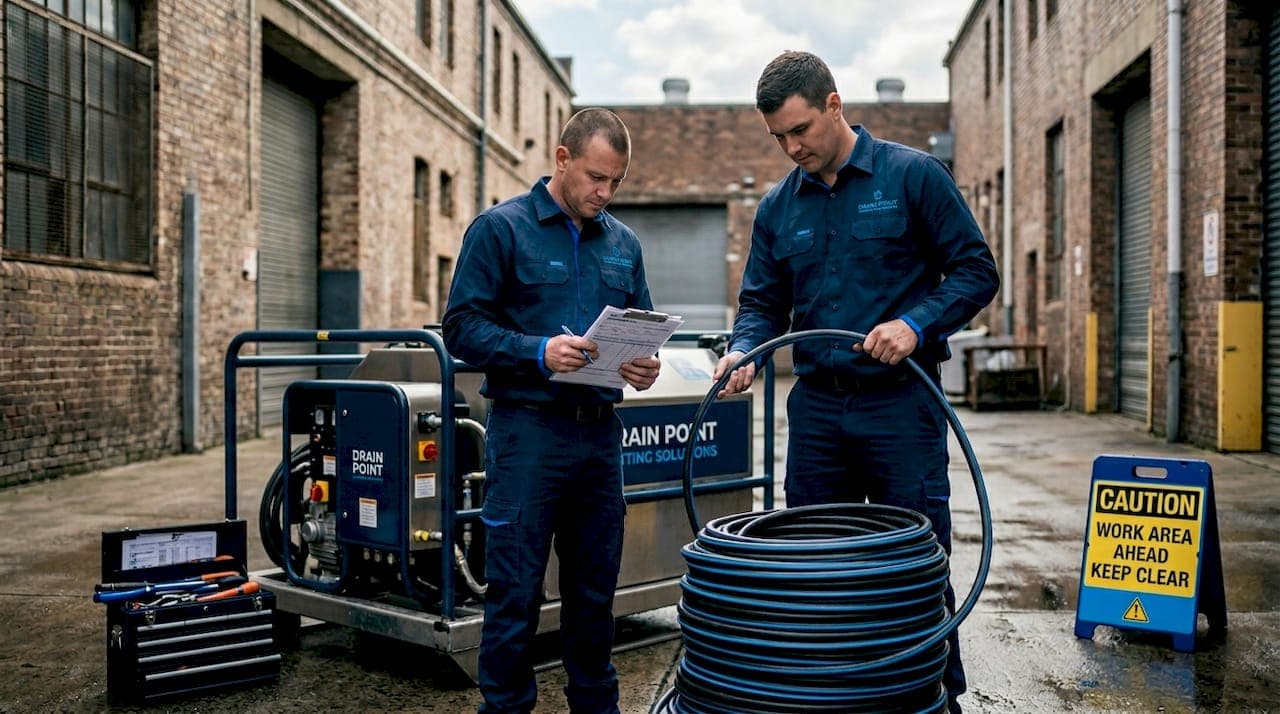
Recurring drain blockages in commercial properties don't just cause headaches. They stop operations, create health hazards, and cost real money every time a plumber shows up with a snake that only punches a temporary hole through the clog. If you're ready to choose commercial hydro jetting service providers that actually solve the problem rather than delay it, this guide gives you a clear, practical framework. You'll learn what to verify before the work starts, how to evaluate vendors, what mistakes to avoid, and how to confirm the job was done right.
Table of Contents
- Key Takeaways
- How to choose a commercial hydro jetting service
- Selecting the right service provider
- Mistakes that cost you money
- What to expect after the job
- My honest take on choosing a jetting company
- Get reliable commercial hydro jetting from Drainpointplumbing
- FAQ
Key Takeaways
| Point | Details |
|---|---|
| Inspect before jetting | Always require a camera inspection before work begins to protect pipe integrity and document baseline condition. |
| Match equipment to your pipes | Effective cleaning depends on matching PSI and GPM to your pipe diameter, not just using the highest-pressure unit available. |
| Verify credentials and coverage | Licensed, insured vendors with commercial experience protect you from liability if pipe damage is claimed after the job. |
| Don't judge on price alone | Hydro jetting costs more upfront than snaking but reduces repeat service calls and long-term operational disruption. |
| Confirm results with post-job inspection | A post-job camera review gives you documented proof that lines are clear and in good condition. |
How to choose a commercial hydro jetting service
Before you start calling vendors, you need to understand what separates hydro jetting from standard drain cleaning. Hydro jetting, the industry term for high-pressure water jetting of sewer and drain lines, doesn't just clear a blockage. It cleans the pipe walls of grease, sludge, hardened mineral deposits, and even tree root intrusion. That's a fundamentally different outcome than snaking, which pokes a path through debris and leaves buildup along the walls.
That distinction matters when you're evaluating what kind of service your property actually needs. If your building has recurring grease or buildup blockages, hydro jetting is the right tool. If it's a one-time soft clog, a drain snake may be sufficient and cheaper.
Pipe material and condition come first
Not every pipe can handle high-pressure jetting. Cast iron, clay tile, and older clay pipe can be compromised by jetting pressure if they're already cracked or corroded. High-pressure jetting on compromised pipes can cause damage that becomes the subject of a dispute, and liability often falls on the last contractor on site. This is why pre-job camera inspection is non-negotiable.
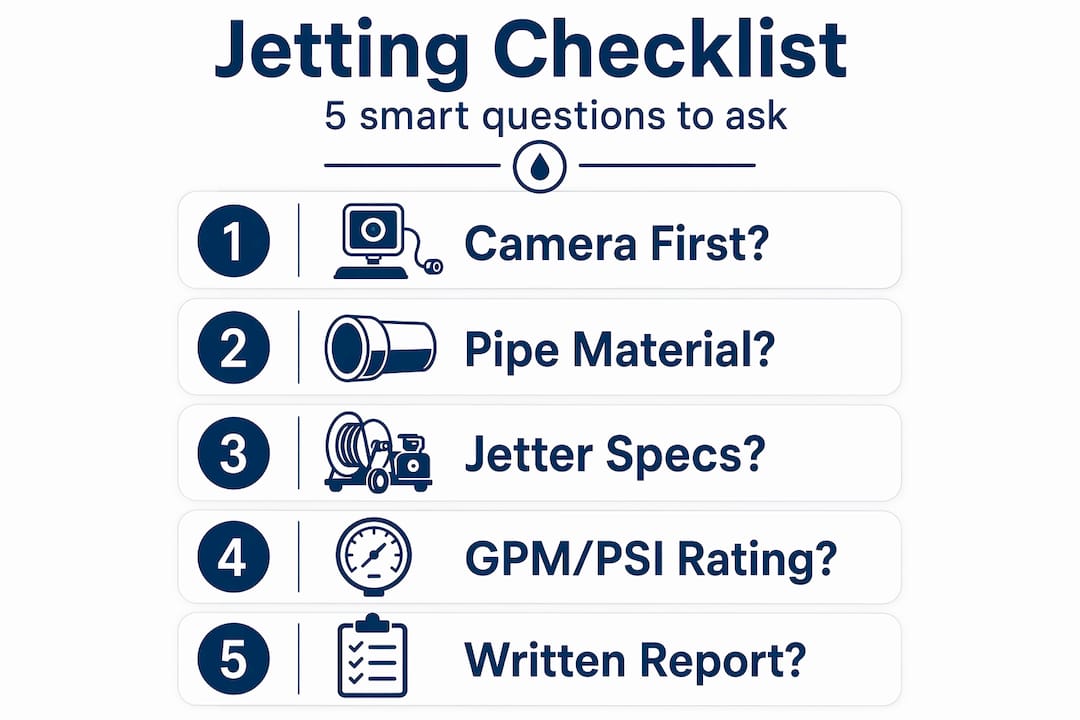
A reputable vendor will always want to run a camera before starting work. If a company quotes you without asking about pipe age, material, or condition, that's a red flag. The inspection documents the baseline state of your pipes, which protects both you and the contractor.
Equipment specs matter more than you think
Choosing jetter specs based on pipe diameter is how professionals determine what machine fits the job. Two numbers define the equipment: PSI (pressure) and GPM (gallons per minute, which measures flow). Most people focus only on PSI, but flow is equally important. High PSI without sufficient GPM means the water cuts through debris but doesn't flush it downstream effectively.
For commercial lines, particularly those dealing with root intrusion or heavy grease, you need gas-powered equipment with higher GPM output. Electric jetters work for smaller residential lines but lack the power for serious commercial systems.
Pro Tip: Ask vendors specifically what PSI and GPM rating their equipment runs for commercial jobs. If they can't answer that question clearly, they're probably not the right fit for your property.
Selecting the right service provider
Once you understand the technical requirements, you can move through the vendor selection process with a clear head. Here's how to work through it.
-
Evaluate equipment capabilities. Ask the vendor what machine they're bringing, what PSI and GPM it delivers, and whether they use different nozzle types for different clogs. Nozzle selection affects how effectively root masses or grease deposits are cut and flushed. A provider who tailors their setup to your specific situation is showing you they know what they're doing.
-
Confirm the full scope of service. A trustworthy provider should offer pre-inspection, cleaning with documentation, and a post-job camera review. End-to-end documentation is the standard for quality commercial work. If a vendor only offers cleaning without inspection, you have no way to verify results or protect yourself against damage claims.
-
Check licensing and insurance. This is basic but often skipped. Verify that the company holds a current contractor's license in California and carries general liability insurance and workers' compensation. Liability for post-job pipe failures can land on the last contractor who touched the system. You don't want to absorb that risk because you skipped a quick license check.
-
Ask about commercial-specific experience. Residential jobs and commercial jobs are very different in scale, pipe size, and consequence. Ask how many commercial properties the provider services regularly, and whether they have experience with your building type (restaurant, office, retail, industrial).
-
Compare pricing models thoughtfully. Hydro jetting can be 67% to 220% more expensive upfront than snaking. That cost differential is real. But when you factor in the reduced frequency of repeat service calls, less downtime, and the long-term benefits for pipe lifespan, the math usually favors jetting for commercial properties with recurring issues.
Beyond these steps, check recent reviews on Google or industry-specific platforms and ask for references from other commercial clients. A company that does good work has customers willing to say so.
- Look for consistent mention of punctuality and post-job follow-through
- Verify that reviews reference commercial properties, not just residential
- Ask specifically whether the company has handled sewer lines of similar diameter to yours
- Confirm they provide written reports, not just a verbal okay after the job
Mistakes that cost you money
Avoiding bad decisions is just as valuable as making good ones. These are the most common errors property managers and business owners make when selecting commercial jetting solutions.
-
Skipping the pre-job inspection. This is the single costliest shortcut. Without a camera inspection, neither you nor the vendor knows the baseline condition of the pipes. If a line collapses or a joint separates during jetting, there's no documentation showing whether that damage was pre-existing. You can learn more about camera inspection services and why they matter before any high-pressure cleaning begins.
-
Fixating on PSI alone. Maximum pressure sounds impressive but doesn't guarantee results. GPM drives debris out of the line. A vendor boasting "4,000 PSI" without context is missing half the equation.
-
Choosing the cheapest quote without asking why it's cheap. Affordable hydro jetting options exist, but unusually low bids often mean no inspection, minimal insurance, or underpowered equipment. The savings evaporate the first time something goes wrong.
-
Not asking about post-job support. What happens if your drains back up within 30 days of service? Does the company offer any guarantee or return visit? Vendors who stand behind their work say so upfront.
-
Ignoring vendor communication quality. A contractor who can't explain their process clearly before the job won't communicate well when something unexpected comes up during it. Clear, direct communication is a practical indicator of professionalism.
Pro Tip: Before signing anything, ask the vendor to walk you through exactly what will happen from arrival to departure, including what their process is if they discover damaged pipe during inspection. Their answer tells you a lot.
What to expect after the job
A properly executed hydro jetting service has measurable, verifiable outcomes. Here's what you should see and document.
| Outcome | What to look for |
|---|---|
| Full flow restoration | Drains should run at normal capacity with no standing water or slow drainage |
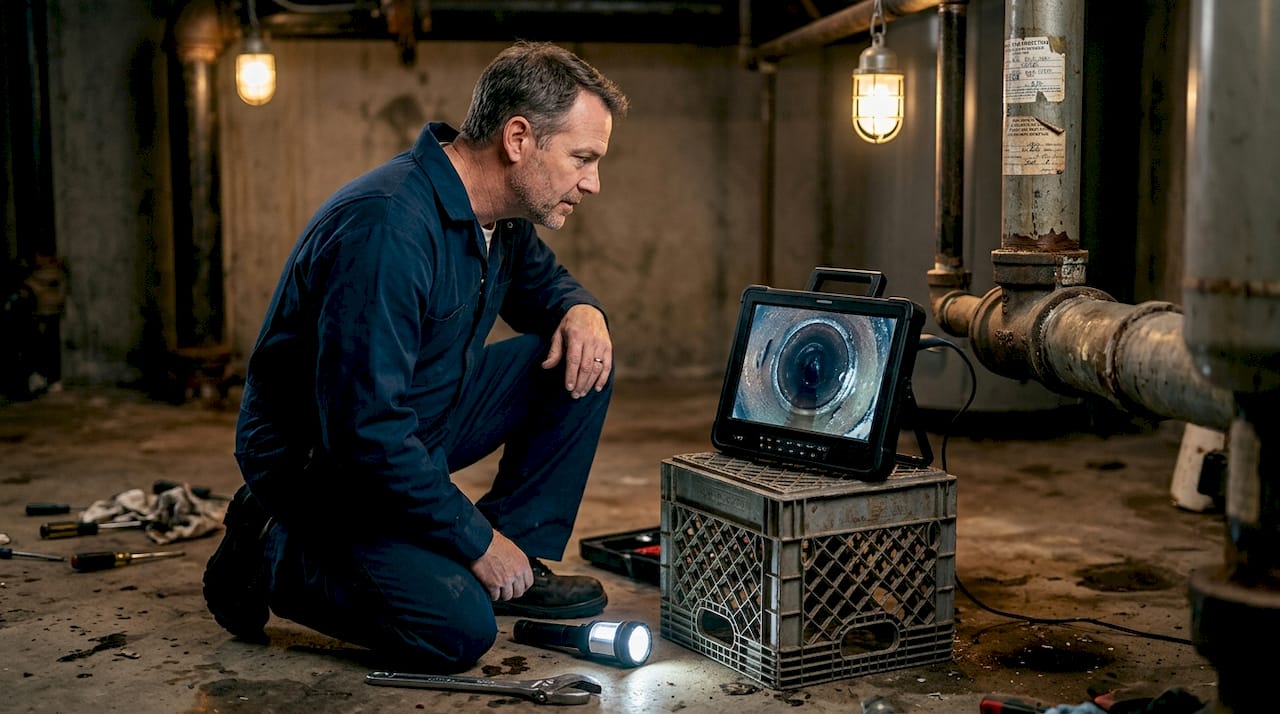
| Debris clearance | Post-job camera should show clean pipe walls with no visible buildup or obstruction |
| Pipe condition documentation | Written or video report showing pipe interior before and after cleaning |
| No new damage present | Camera should confirm no joint separation, cracking, or collapse caused by jetting |
The post-job camera inspection is your quality assurance. Pre- and post-job camera inspections are both practical and necessary for documenting results, preventing disputes, and confirming that the cleaning was thorough. Ask for a copy of the video footage and written summary.
Long-term, regular hydro jetting as part of a commercial drain maintenance plan significantly reduces clog frequency and extends the functional lifespan of your pipes. For restaurants, food processing facilities, or any property with high grease load, scheduled jetting every 6 to 12 months is a sound operating practice.
"The question isn't whether commercial hydro jetting pays off. It's whether your current approach to drain maintenance is costing you more in recurring emergencies than a properly maintained jetting schedule would."
If post-service problems arise, contact the provider immediately and reference the pre-job inspection report. Any reputable contractor will return to assess and address the issue. If they don't, that's documentation you may need for an insurance or legal claim.
My honest take on choosing a jetting company
I've reviewed hundreds of commercial plumbing service scenarios over the years, and the pattern I see most often is this: business owners wait until a drain becomes an emergency before calling anyone, then choose whoever answers the phone fastest and quotes lowest.
That approach works fine once. The second time it costs twice as much.
What I've learned is that the inspection step is where most vendors show their real quality. A company that pushes back when you ask for a pre-job camera review, or that charges extra to simply document what they found, is telling you something. They're telling you that documentation makes them uncomfortable. That should make you uncomfortable too.
The other thing I'd push back on is the idea that higher PSI automatically means a better vendor. I've seen properties where an operator ran maximum pressure through aging clay tile and cracked a lateral line. The repair bill dwarfed the original jetting cost several times over. Matching equipment to pipe conditions is what separates a professional from someone with a truck and a machine.
One last thing: get a service contract for scheduled maintenance once you find a provider you trust. Reactive plumbing is expensive. Proactive plumbing is a budget line you control.
— Kirk
Get reliable commercial hydro jetting from Drainpointplumbing
Drainpointplumbing has served commercial and residential clients across Santa Barbara County for over 15 years, and hydro jetting is one of their core specialties. Every job starts with a camera inspection to document pipe condition before any pressure hits the line. Their licensed and insured technicians match equipment specs to your specific pipe size and clog type, and they provide written documentation of results. Whether you manage a restaurant, office complex, or retail property, Drainpointplumbing offers tailored commercial jetting solutions backed by real accountability. Ready to stop reacting to clogs and start preventing them? Request a free quote and get a maintenance plan built around your property.
FAQ
What is hydro jetting and how does it clear commercial lines?
Hydro jetting uses high-pressure water delivered through specialized nozzles to cut through and flush out grease, sludge, scale, and root intrusion from pipe walls. Unlike snaking, it cleans the entire interior surface of the line rather than just punching through a blockage.
Why does GPM matter as much as PSI in commercial jetting?
PSI cuts through blockages, but GPM moves debris out of the pipe. High pressure without adequate flow leaves loosened material in the line, which quickly rebuilds into a new clog.
How much does commercial hydro jetting cost compared to snaking?
Hydro jetting typically costs 67% to 220% more upfront than drain snaking, but it reduces recurring service calls and the risk of unplanned downtime, making it more cost-effective for properties with frequent blockages.
Do I need a camera inspection before hydro jetting?
Yes. A pre-job camera inspection confirms pipe integrity and documents baseline condition. Running high pressure through already compromised pipes can cause serious damage, and without documentation, liability becomes contested.
How often should commercial properties schedule hydro jetting?
For properties with high grease loads, such as restaurants or food facilities, scheduling jetting every 6 to 12 months is a practical maintenance standard. Lower-demand properties may only need it annually or when specific issues arise.