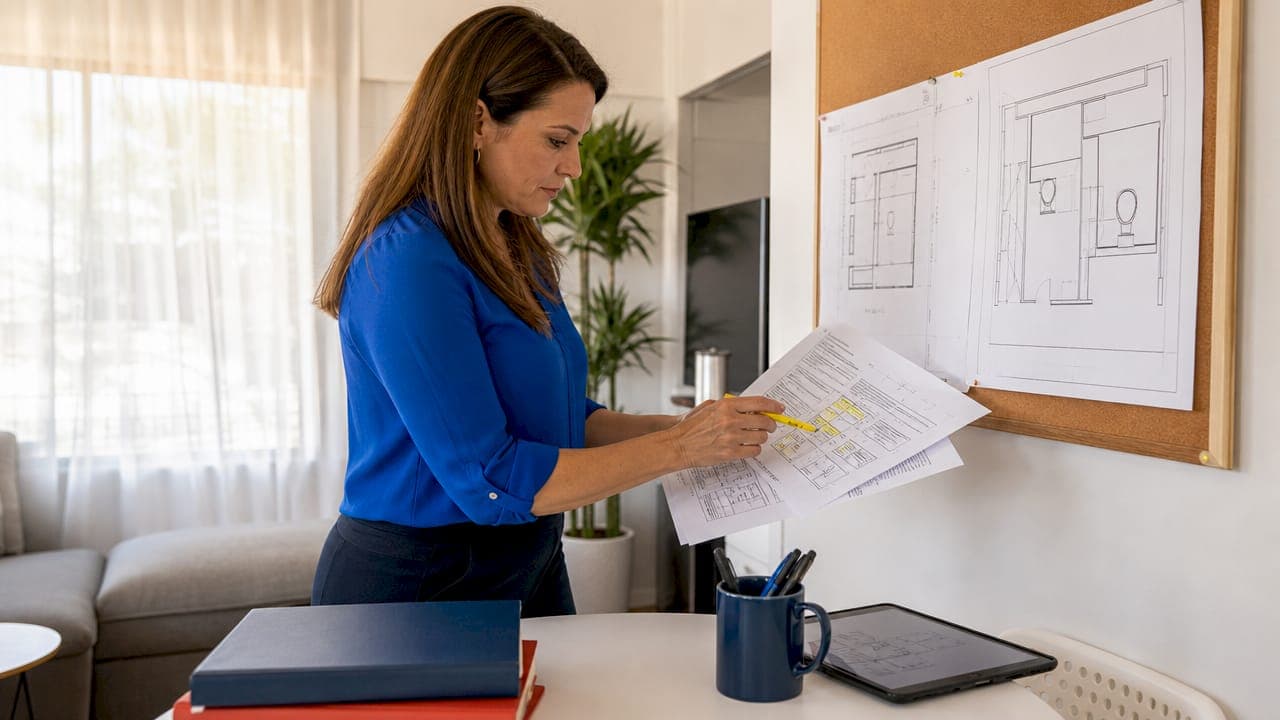
Plumbing configuration is the single most decisive factor in whether a commercial restroom achieves genuine ADA compliance, because it controls clearances, fixture heights, pipe safety, and operable controls at the point of installation. Building owners and facility managers who treat ADA compliance as a product selection exercise routinely discover that a fixture labeled "ADA compliant" fails inspection once it is mounted on a standard vanity, connected with a center drain, or paired with a faucet requiring two hands to operate. The Americans with Disabilities Act, specifically ADA Chapter 6, governs plumbing elements directly, covering everything from knee clearance dimensions to pipe insulation requirements. Understanding how plumbing affects ADA compliance means looking past the spec sheet and into the assembled, installed condition of every fixture in the room.
How plumbing affects ADA compliance: the core requirements
ADA compliance in commercial plumbing is defined by specific dimensional and operational standards that apply to the installed condition, not the product box. These requirements come from ADA Chapter 6, DOJ guidance, and the International Plumbing Code as it intersects with federal accessibility law.
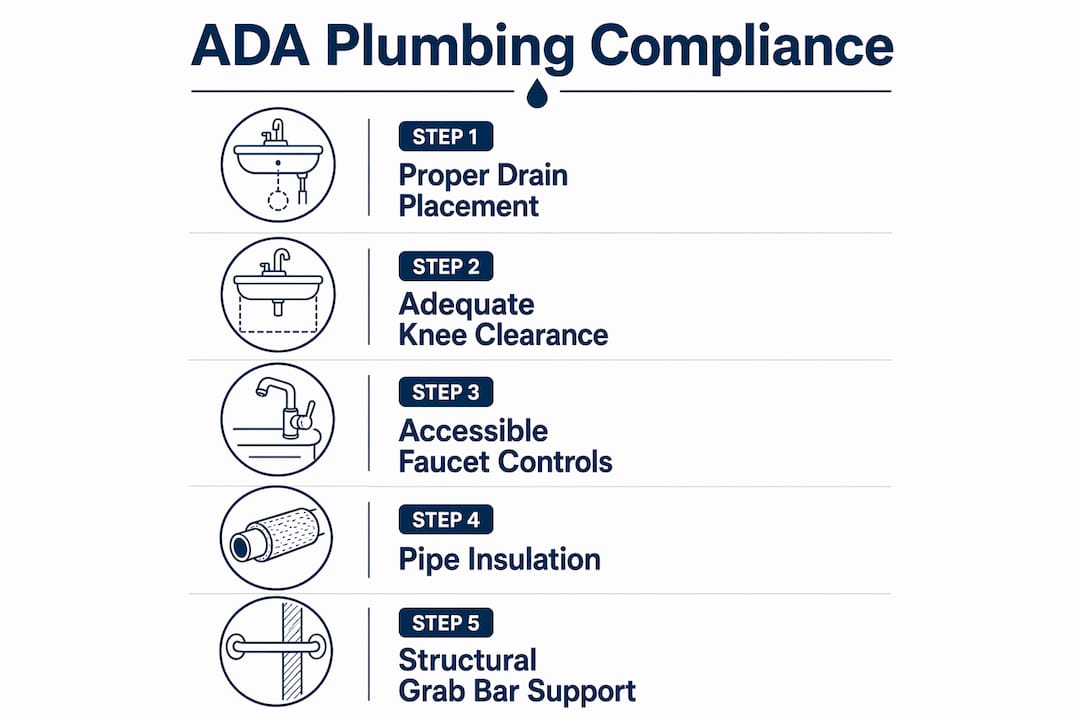
Knee and toe clearance under lavatories is the most frequently cited plumbing failure point. The ADA mandates minimum knee clearance of 27 inches high, 30 inches wide, and between 11 and 25 inches deep beneath sinks. This space must remain unobstructed, which means drain traps, supply lines, and pipe insulation all factor into whether the clearance is actually usable. The lavatory rim, measured at the installed height including countertop and vanity thickness, cannot exceed 34 inches from the finished floor.
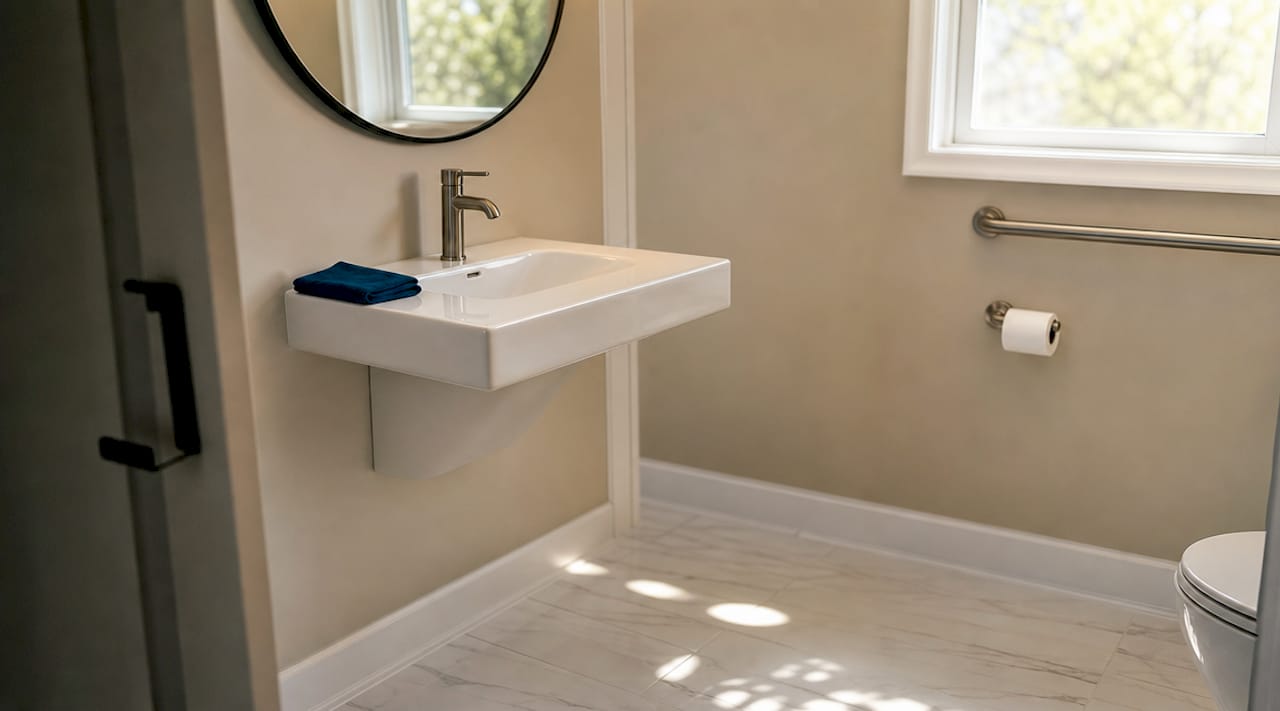
Clear floor space in front of each fixture requires a minimum 30 by 48 inch unobstructed zone. This is where wheelchair users position themselves for a forward or parallel approach, and any plumbing that intrudes into this zone creates a barrier. Accessible restrooms also require a 60-inch turning diameter or a T-shaped equivalent to allow wheelchair maneuvering, which directly constrains where plumbing fixtures and supply lines can be routed.
Faucet operability is a non-negotiable plumbing requirement. Controls must be operable with one hand without tight grasping, pinching, or twisting, and must require no more than 5 pounds of force to activate. Single-lever faucets and touchless sensor models both satisfy this standard. Blade-style handles, wrist-blade controls, and push-button activators are also acceptable. Standard round knobs are not.
Pipe insulation is a safety requirement that directly affects plumbing installation scope. Exposed hot water and drain pipes under accessible sinks must be insulated or covered to prevent contact burns for users who have limited sensation, including many wheelchair users. This is not optional and is one of the most commonly missed items during inspection.
Grab bar structural support ties plumbing and structural work together. Grab bars must withstand 250 pounds of force, which requires solid blocking in the wall behind the bar. Plumbing vent stacks, supply lines, and drain runs frequently occupy the same wall cavities where blocking is needed, creating conflicts that must be resolved at the rough-in stage.
How improper plumbing installations cause ADA failures
The most expensive lesson facility managers learn is that ADA compliance is less about selecting compliant products and more about verifying the complete installed condition. Coordination failures between plumbing, structural, and finish work are the primary source of non-compliance in commercial buildings.
Center drain placement is the most common single cause of knee clearance failure. Standard sink drains are centered under the basin, which positions the P-trap directly in the knee clearance zone. A wheelchair user cannot roll under the sink because the trap blocks the required 11 to 25 inch depth. The fix requires rear-set or offset drains that route the trap to the side or rear of the cabinet, keeping the knee space open. This is a rough-in decision, not a fixture decision.
Incorrect rough-in heights compound the problem when vanity or countertop thickness is not accounted for before purchasing fixtures. A sink that measures 33 inches at the rim in the showroom can easily exceed 34 inches once it sits on a standard 1.5-inch countertop mounted on a 32-inch vanity. The assembled height is what the inspector measures, not the fixture specification.
Omitted pipe insulation is caught during virtually every professional ADA audit. The insulation requirement is clear in the standard, yet plumbers routinely complete installations without it because it is not part of standard residential practice. In commercial spaces, this omission creates both a compliance violation and a genuine burn risk.
Faucet placement outside the reach range occurs when plumbing rough-ins are set without accounting for the forward reach limit from a seated position. Controls placed too far back on a deep countertop may be physically unreachable from a wheelchair, even if the faucet itself is a compliant single-lever model.
Grab bar blocking conflicts are a major cost driver. Hidden conflicts between required grab bar blocking and existing plumbing, vent stacks, or electrical chases are frequently discovered only after demolition begins, causing project delays and cost overruns. Planning this coordination before breaking ground is the only reliable way to avoid it.
Pro Tip: Before any fixture is purchased for an ADA renovation, pull the rough-in drawings and confirm drain location, supply line positions, and wall cavity contents. Changing a drain location after tile is set costs far more than adjusting it during rough-in.
What facility managers can do to get plumbing right
Achieving compliant plumbing in commercial buildings is a coordination and verification process, not a shopping exercise. The following steps reflect what experienced facility managers and access consultants actually do on successful projects.
-
Verify rough-in locations before purchasing fixtures. Confirm drain position, supply line height, and wall blocking availability before specifying any sink, toilet, or shower assembly. This single step prevents the majority of costly retrofits.
-
Select paired sink and faucet assemblies with documented compliance under installed conditions. Request installation guides that show the assembled height including countertop, the drain location relative to the knee clearance zone, and the reach range for faucet controls. An ADA-labeled sink does not guarantee compliance once it is mounted.
-
Coordinate plumbing and structural blocking for grab bars during rough-in. Share the grab bar layout with your plumber before walls are closed. Vent stacks and supply lines must be routed around blocking locations, not through them.
-
Engage a Certified Access Specialist (CASp) for audits. No federal ADA certification program exists for facilities, so CASp professionals fill this role. A CASp audit identifies specific plumbing deficiencies with remediation priorities, which is far more useful than a general contractor's sign-off.
-
Apply the "readily achievable" standard strategically for existing buildings. New construction after March 2012 must fully comply with ADA. Existing buildings must remove barriers only when doing so is readily achievable, meaning without significant difficulty or expense. The DOJ prioritizes restroom access third, after facility entry and access to goods and services. This gives facility managers a defensible framework for phasing plumbing upgrades over time.
-
Prepare complete submittal packages. For any permitted renovation, include clearance diagrams showing knee space, clear floor space, and turning radius alongside plumbing rough-in drawings. Inspectors and CASp reviewers need to see the assembled condition on paper before they see it in the field.
Pro Tip: Request that your plumber photograph all rough-in locations before walls are closed. These photos become your compliance documentation and your defense if a fixture height is later questioned.
How plumbing design supports universal access beyond ADA minimums
ADA standards set the floor, not the ceiling. Facility managers who plan plumbing with universal design principles in mind build spaces that serve a wider range of users and require fewer costly modifications as occupant needs change.
Flexible plumbing materials like PEX allow fixture placement to be adjusted more easily during future renovations than rigid copper or CPVC systems. This matters when a tenant changes, when an employee's needs shift, or when accessibility standards are updated. Installing PEX during a renovation adds minimal cost and preserves significant future flexibility.
Wall-hung sinks are the most effective plumbing choice for open knee clearance. Because the sink mounts directly to the wall with no vanity cabinet below, the drain and supply lines can be routed to the side or rear, and the knee space remains fully open. The mounting height is also adjustable at installation, which is not possible with a cabinet-mounted sink.
The following table compares standard plumbing choices against universal design alternatives across key compliance dimensions:
| Feature | Standard installation | Universal design approach |
|---|---|---|
| Sink mounting | Cabinet-mounted, fixed height | Wall-hung, height adjustable |
| Drain location | Center, blocks knee space | Rear-set or offset, knee space clear |
| Faucet type | Round knob, two-hand operation | Single-lever or sensor, one-hand operable |
| Pipe material | Rigid copper or CPVC | PEX, flexible and repositionable |
| Shower entry | Curbed, step-over required | Curbless, zero-threshold entry |
| Water temperature | Standard mixing at fixture | Thermostatic mixing valve, scald protection |
Thermostatic mixing valves and pressure-balanced shower valves are plumbing investments that directly support safety for users with limited sensation or mobility. These valves maintain water temperature within a narrow range regardless of supply pressure changes, preventing scalding without requiring the user to adjust controls. Universal design plumbing treats these as standard, not optional.
Installing reinforcement blocking in walls during any renovation, even in spaces not currently designated as accessible, costs very little at rough-in and eliminates the need to open walls later when grab bars are needed. The same logic applies to curbless shower drains: a properly sloped floor drain installed now costs far less than cutting and re-pouring a slab later.
Pro Tip: When planning any commercial restroom renovation, install blocking in all walls at grab bar height, even in stalls not currently designated as accessible. The cost difference at rough-in is negligible. The cost of adding it later is not.
Key takeaways
Plumbing configuration determines ADA compliance outcomes in commercial restrooms because clearances, fixture heights, pipe safety, and operable controls are all set at the point of installation, not at the point of product selection.
| Point | Details |
|---|---|
| Installed condition controls compliance | ADA compliance is measured at the assembled fixture height and clearance, not the product specification. |
| Center drains cause knee clearance failures | Rear-set or offset drains are required to keep the 27-inch knee clearance zone unobstructed. |
| Pipe insulation is mandatory | Exposed hot water and drain pipes under accessible sinks must be insulated to prevent burns. |
| Rough-in coordination prevents cost overruns | Grab bar blocking, drain location, and supply line routing must be resolved before walls are closed. |
| CASp audits replace implied compliance | No federal ADA facility certification exists; Certified Access Specialists provide the only reliable verification. |
Why plumbing coordination is the real compliance challenge
After more than 15 years working on commercial plumbing projects across Santa Barbara County, I can tell you that the most common ADA failure I see has nothing to do with the fixtures themselves. It is the gap between what was specified and what was actually installed. A facility manager selects a compliant sink, approves a compliant faucet, and signs off on a renovation, then discovers during a CASp audit that the center drain blocks the knee space, the pipe insulation was never installed, and the grab bar backing conflicts with a vent stack nobody mapped before the walls closed.
The uncomfortable truth is that many facilities rely on implied compliance and signage rather than verified installed conditions. A blue accessibility symbol on a restroom door does not make the plumbing inside compliant. What makes it compliant is a plumber who understands the clearance requirements, a contractor who coordinates blocking with rough-in, and a facility manager who asks for documentation before the walls close.
The "readily achievable" standard gives existing building owners real flexibility, but it is not a pass on doing the work. It is a framework for prioritizing it. Start with the restroom. Get a CASp audit. Fix the drain location and the pipe insulation first, because those are the failures that create both legal exposure and genuine physical harm. Then plan the grab bars and the turning space as budget allows.
Plumbing is the hidden skeleton of an accessible space. When it is coordinated well, users with disabilities move through a building with independence. When it is not, a compliant-looking restroom becomes a barrier the moment someone in a wheelchair tries to use it.
— Kirk
Get ADA-compliant plumbing right the first time with Drainpointplumbing
If your commercial building in Santa Maria or anywhere in Santa Barbara County needs a plumbing assessment for ADA compliance, Drainpointplumbing has the experience to identify exactly where your installations fall short and what it takes to fix them.
Drainpointplumbing provides fixture replacements and plumbing repairs tailored to accessibility requirements, including wall-hung sink installations, offset drain configurations, pipe insulation, and faucet upgrades. With over 15 years serving commercial and residential clients across Santa Barbara County, the team understands the difference between a fixture that looks compliant and one that actually is. Request a free plumbing quote and get a clear picture of where your building stands before an inspector or a lawsuit does it for you.
FAQ
What plumbing dimensions does ADA require under sinks?
ADA requires knee clearance of at least 27 inches high, 30 inches wide, and 11 to 25 inches deep beneath accessible lavatories, with the rim height not exceeding 34 inches at the installed condition including countertop thickness.
Does an ADA-labeled sink guarantee compliance?
No. An ADA-labeled sink does not guarantee compliance once installed, because the assembled height, drain location, and plumbing configuration all affect whether the fixture meets clearance and operability requirements in the actual space.
What faucet types satisfy ADA operable controls requirements?
Single-lever faucets, wrist-blade controls, and touchless sensor models all satisfy ADA requirements, which mandate one-hand operation without grasping or twisting and a maximum activation force of 5 pounds.
Are existing commercial buildings required to fully retrofit plumbing for ADA?
Existing buildings must remove barriers only when doing so is readily achievable, meaning without significant difficulty or expense. Full compliance is required only for new construction or significant alterations completed after March 2012.
Who can certify that a commercial restroom's plumbing is ADA compliant?
No federal ADA certification program exists for facilities. Certified Access Specialists (CASp) are the recognized professionals who audit commercial spaces and provide documented compliance assessments with specific remediation guidance.