
Coordinating an emergency plumbing vendor for commercial properties is defined as the structured process of identifying, contacting, and directing a licensed commercial plumbing contractor to resolve urgent infrastructure failures before they escalate into costly operational shutdowns. When a burst pipe floods a server room or a sewage backup shuts down a restaurant kitchen, every minute of delay compounds the damage. Property managers who know how to coordinate emergency plumbing services correctly, with the right vendor, the right information, and the right communication protocol, consistently achieve faster resolution and lower total repair costs than those who improvise under pressure.
What information must you have before calling an emergency plumbing vendor?
The single most effective thing you can do before dialing a vendor is organize your facts. Commercial property managers must provide the exact property address and a clear description of the emergency to a live dispatcher immediately, because accurate information is what allows the vendor to assign the right crew, load the right equipment, and calculate a realistic ETA. Calling without this information forces the dispatcher to ask clarifying questions, which burns time you do not have.
Here is what to have ready before you make the call:
- Full property address, including suite number, floor, and any access gate codes
- Emergency type, stated clearly: burst pipe, sewage backup, gas leak, water heater failure, or fixture collapse
- Affected area, such as the basement mechanical room, second-floor restrooms, or main kitchen line
- Water shutoff status, meaning whether you have already isolated the water supply or need guidance to do so
- Number of tenants or occupants currently on site and whether evacuation is needed
- Your callback number and the name of the on-site contact who will meet the crew
Commercial emergencies include burst pipes, sewer backups, gas leaks, and high-risk fixture failures that threaten both operations and occupant safety. Knowing which category your situation falls into helps dispatchers triage correctly. Professional vendors target on-site response times of 60 to 90 minutes for urgent calls, but that clock starts only after the dispatcher has enough information to dispatch.
Pro Tip: Read our guide on describing a plumbing emergency to a dispatcher before an emergency happens. Practicing the conversation in advance cuts your call time by half when it counts most.
One more critical point: live calls to dedicated emergency lines take priority over online contact forms, which route into callback queues and can delay response by hours. Never use a general website contact form during an active emergency. Call the 24/7 line directly and speak to a person.
How do you select and evaluate commercial emergency plumbing vendors?
Not every licensed plumber is equipped to handle a commercial crisis. Commercial infrastructure requires specialized services that are distinct from residential work, and residential plumbers often lack both the equipment and the certifications required for high-volume commercial systems. Hiring the wrong vendor can mean a repeat visit, extended downtime, and a failed inspection.
Use this comparison to evaluate vendors before an emergency forces your hand:
| Criteria | What to look for | Red flag |
|---|---|---|
| Licensing | Licensed Master Plumber with commercial endorsement | General contractor license only |
| Equipment | Hydro-jetters, pipe repair materials, water mitigation tools | Residential-grade tools only |
| Availability | True 24/7 dispatch with live operators | "On-call" with no guaranteed response |
| Documentation | Timestamped photos, written assessments, insurance-ready reports | Verbal-only summaries |
| Response time | Committed 60 to 90 minute window | Vague "as soon as possible" language |
| Commercial experience | Verifiable references from office buildings, retail, or industrial sites | Residential portfolio only |
Commercial plumbing requires full licensing, insurance, and compliance knowledge to meet health and safety codes under high-volume use. This is not a negotiable standard. Ask vendors directly whether their crew holds commercial plumbing training and carries appropriate equipment such as commercial-grade hydro-jetters before you add them to your approved vendor list.
Emergency dispatch systems with live operators and real-time equipment tracking enhance response speed and coordination effectiveness. When you call a vendor and reach a live operator who can tell you which crew is closest and what they are carrying, that is a sign of a mature operation. When you reach a voicemail, move to your next option.
Pro Tip: Build your approved vendor list before any emergency occurs. Vet at least two commercial plumbing contractors per region you manage, confirm their 24/7 availability, and store their direct emergency numbers in your facility management software.
Step-by-step process to coordinate emergency plumbing service during a crisis
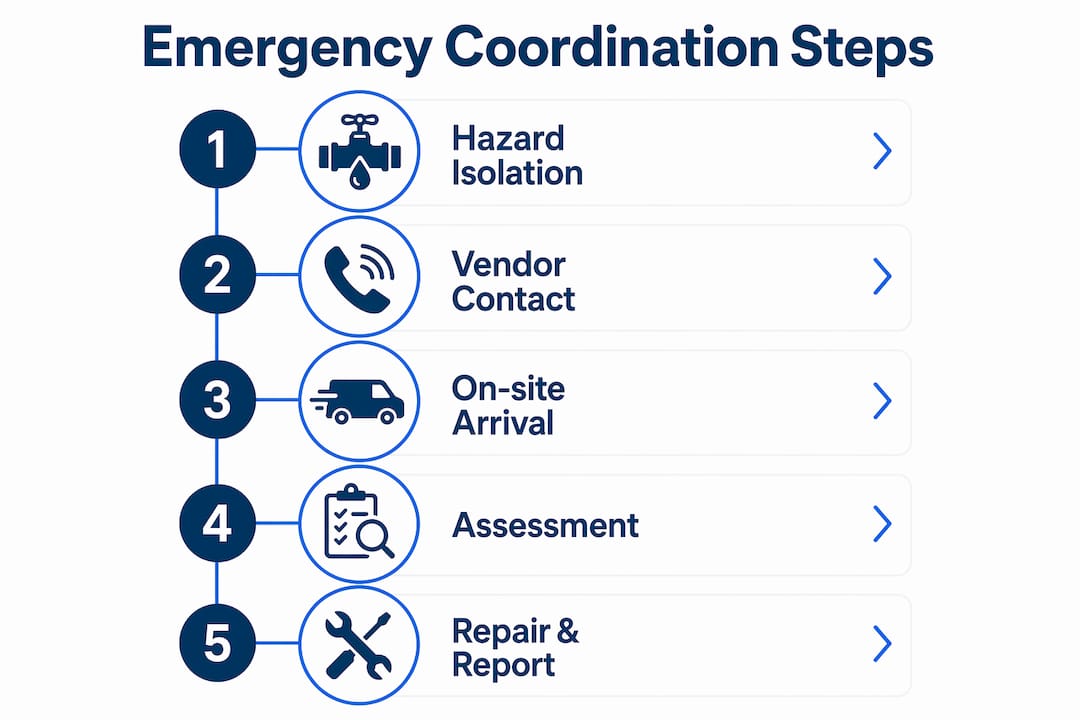
Structured coordination is what separates a two-hour resolution from a two-day shutdown. Follow this workflow from the moment you identify the emergency through final documentation.
- Isolate the hazard. Shut off the main water supply or the affected zone valve immediately. If a gas leak is suspected, evacuate the area and call your gas utility before calling a plumber.
- Call the vendor's 24/7 emergency line directly. State your address, emergency type, and on-site contact name. Confirm the expected arrival window. A committed vendor will give you a 60 to 90 minute response target on the call.
- Notify building stakeholders. Alert tenants, building security, and your property ownership group within the first 10 minutes. Use a pre-written emergency notification template if you have one.
- Prepare site access. Unlock mechanical rooms, disable any access control systems that would block the crew, and designate a staff member to meet the vendor at the entrance.
- Document the damage before the crew arrives. Take timestamped photos and video of the affected area. This protects you during the insurance claim process regardless of what the vendor documents.
- Brief the crew on arrival. Walk the lead plumber through the affected area, share any relevant building schematics, and confirm the scope of work before they begin.
- Manage tenant communication during repairs. Send brief, factual updates every 30 to 60 minutes. Silence breeds rumors and complaints.
- Collect documentation before the crew leaves. Demand timestamped documentation including photos and a detailed on-site assessment before the crew departs. This is your primary evidence for insurance claims and compliance records.
- Schedule follow-up repairs during off-hours. Non-critical repairs scheduled during evenings or weekends minimize business disruption for tenants and staff.
The table below shows how response phases map to time targets in a well-coordinated commercial emergency:
| Phase | Target time | Responsible party |
|---|---|---|
| Hazard isolation | 0 to 5 minutes | Property manager or on-site staff |
| Vendor call and dispatch | 5 to 10 minutes | Property manager |
| Stakeholder notification | 10 to 20 minutes | Property manager |
| Vendor on-site arrival | 60 to 90 minutes | Plumbing vendor |
| Damage assessment complete | Within 30 minutes of arrival | Vendor crew |
| Documentation delivered | Before crew departure | Vendor crew |
Understanding how after-hours dispatch works for commercial emergencies gives you a significant advantage when managing the vendor relationship in real time.
Common mistakes that derail commercial plumbing emergency coordination
Even experienced property managers make avoidable errors under pressure. Knowing where coordination typically breaks down lets you build safeguards before the next incident.
- Using online contact forms during active emergencies. This is the single most common delay-causing mistake. Forms route to email queues, not dispatch centers. Always call the dedicated emergency line.
- Hiring a residential plumber for a commercial job. A plumber without commercial experience or commercial-grade equipment will often diagnose incorrectly, lack the tools to complete the repair in one visit, and fail to meet code requirements. Confirm the arriving crew holds commercial plumbing training and carries appropriate equipment before they begin work.
- Skipping documentation. Poor or absent documentation is the leading cause of denied or reduced insurance claims after commercial water damage events. Require written, timestamped reports with photos as a non-negotiable condition of service.
- Scheduling emergency follow-up work during peak business hours. Repairs that can wait 12 hours should wait for off-hours. Disrupting tenant operations unnecessarily creates liability and damages relationships.
- Neglecting preventive maintenance. Maintenance on grease traps, backflow preventers, and main sewer lines is a proven method for reducing emergency repair events. A quarterly maintenance contract with a commercial plumbing vendor costs a fraction of a single emergency call, and it dramatically reduces the frequency of those calls.
- Failing to pre-qualify vendors. Searching for a vendor during an active emergency means accepting whoever answers first, which is rarely the best option. Pre-qualify at least two vendors per property and review their credentials annually.
Reviewing common after-hours plumbing mistakes as a team exercise before an emergency occurs is one of the highest-return preparation activities a property management team can do.
Key takeaways
Effective commercial emergency plumbing coordination requires pre-qualified vendors, precise information delivery to live dispatchers, and mandatory timestamped documentation before the crew leaves the site.
| Point | Details |
|---|---|
| Call live dispatchers directly | Online forms delay response. Always call the dedicated 24/7 emergency line. |
| Prepare your information first | Have the address, emergency type, and access details ready before dialing. |
| Verify commercial credentials | Confirm the vendor holds commercial licensing and carries commercial-grade equipment. |
| Demand documentation on-site | Require timestamped photos and written assessments before the crew departs. |
| Prevent with maintenance | Quarterly maintenance on grease traps, backflow preventers, and sewer lines reduces emergency frequency. |
What 15 years of commercial plumbing calls taught me about vendor coordination
Most property managers treat vendor coordination as a reactive task. They wait for the emergency, then scramble. That approach is expensive, and it is entirely avoidable.
The managers who handle commercial plumbing crises best are the ones who have already made the decisions. They know which vendor they are calling before the pipe bursts. They have the direct emergency number saved, not buried in a contract folder. They have walked their maintenance staff through the water shutoff locations. When the crisis hits, they are executing a plan, not building one.
The other thing I have seen consistently is the documentation gap. Property managers assume the plumber will handle it. Some do. Many do not. The ones who do not leave you with a verbal summary and a handshake when you need a timestamped photo report for your insurer. Requiring documentation in writing, before the crew leaves, is not being difficult. It is protecting your property and your claim.
One more thing: commercial plumbing specialization matters more than most managers realize. A residential plumber working a commercial job is not just slower. They are often working outside their license scope, using undersized equipment, and making repair decisions based on residential code assumptions that do not apply to your building. The cost difference between a qualified commercial contractor and a general plumber is almost always recovered in the first visit.
— Kirk
How Drainpointplumbing supports commercial emergency plumbing coordination
When a plumbing emergency threatens your commercial property in Santa Barbara County, Drainpointplumbing delivers the structured, licensed response that property managers need. Their 24/7 emergency plumbing services are built specifically for situations where downtime is not an option, with live dispatch, licensed plumbers, and commercial-grade equipment ready to deploy within the 60 to 90 minute response window.
Drainpointplumbing provides the timestamped documentation, on-site assessments, and direct communication that insurance claims and compliance records require. With over 15 years of experience serving commercial and residential clients across Santa Maria and neighboring areas, they are the vendor worth pre-qualifying before the next emergency. Request a quote today and get your property on their priority response list.
FAQ
What does it mean to coordinate an emergency plumbing vendor for commercial properties?
It means identifying a pre-qualified, licensed commercial plumbing contractor, contacting their live dispatch line with precise emergency details, and managing site access and communication through resolution. The goal is to minimize downtime and protect the property from further damage.
How fast should a commercial emergency plumber arrive on-site?
Professional commercial emergency plumbing vendors target on-site arrival within 60 to 90 minutes of a confirmed dispatch. Any vendor that cannot commit to a specific response window during the initial call is not operating a true emergency service.
Why can't I use a residential plumber for a commercial emergency?
Commercial infrastructure requires specialized services that residential plumbers typically lack, including commercial-grade equipment, higher-capacity tools, and compliance knowledge for health and safety codes. Using an unqualified plumber risks code violations, repeat visits, and extended downtime.
What documentation should I require after an emergency plumbing repair?
Require timestamped photos, a written on-site assessment, and a detailed description of all work completed before the crew leaves. This documentation is the primary evidence for insurance claims and regulatory compliance records.
How can I reduce the frequency of commercial plumbing emergencies?
Preventive maintenance on grease traps, backflow preventers, and main sewer lines is the most effective method. A scheduled maintenance contract with a qualified commercial plumbing vendor reduces emergency call frequency and total annual repair costs.