
Plumbing load calculations are standardized methods that convert individual fixture demands into numerical values, enabling accurate pipe sizing and plumbing system design. The core tools are Water Supply Fixture Units (WSFU) and Drainage Fixture Units (DFU), two dimensionless scales that quantify how much water a building's fixtures collectively demand at peak use. Roy B. Hunter developed the foundational probability model behind these calculations in the mid-20th century, and his work still drives the formulas in the International Plumbing Code (IPC) and Uniform Plumbing Code (UPC) today. Understanding how plumbing load calculations work is the difference between a system that performs reliably for decades and one that fails under real-world demand.
How do Water Supply Fixture Units and Drainage Fixture Units work?
WSFU is a dimensionless value assigned to each fixture based on its flow rate, typical usage duration, and the probability it runs simultaneously with other fixtures. The key insight is that the relationship between total WSFU and design flow in gallons per minute (GPM) is non-linear. Doubling the number of fixture units does not double the flow demand. This reflects real-world behavior: not every toilet, sink, and shower in a building runs at the same moment.
Common residential WSFU values give you a concrete starting point:
- Toilet (tank type): 2.5 WSFU
- Lavatory (private): 1.0 WSFU
- Kitchen sink (residential): 1.5 WSFU
- Bathtub/shower: 1.5 WSFU
- Clothes washer: 3.0 WSFU
- Dishwasher: 1.5 WSFU
Commercial fixtures carry higher values because usage frequency is greater. A public restroom lavatory, for example, rates at 2.0 WSFU compared to 1.0 for a private one.
Drainage Fixture Units follow a parallel logic for the drain side of the system. 1 DFU equals approximately 7.5 gallons per minute of intermittent drain flow. A 3-inch horizontal branch handles 20 DFU, while a 3-inch stack handles 48 DFU. A 4-inch stack handles significantly higher loads. These numbers come directly from IPC tables and give contractors a clear ceiling for each pipe segment.

The table below shows typical DFU values for common fixtures:
| Fixture | DFU Value |
|---|---|
| Toilet | 4 |
| Lavatory | 1 |
| Bathtub/shower | 2 |
| Kitchen sink | 2 |
| Clothes washer | 3 |
| Floor drain | 2 |
Supply and drainage demands are measured separately because they behave differently. Supply demand is probabilistic. Drainage demand is based on peak intermittent flow. Both systems require their own sizing calculations, and a mistake in either one creates problems the other cannot compensate for.
What formulas and standards guide plumbing load calculations?
Hunter's Curve is the foundation of supply-side plumbing load estimation. Roy B. Hunter's research produced a probability-based graph that converts total WSFU into a design flow rate in GPM. The IPC codifies this relationship in Table E103.3(3), which builders and engineers use to look up design flow once total fixture units are tallied. The curve flattens as fixture count rises, which is why a 100-unit apartment building does not need pipes sized for 100 simultaneous showers.
The Hazen-Williams equation governs friction loss in pipes. It accounts for flow rate, pipe diameter, pipe roughness, and pipe length. Friction loss calculated via Hazen-Williams directly affects which pipe diameter you select. A pipe that is too narrow creates excessive friction loss and drops pressure below acceptable levels at the fixture.
Velocity limits set a hard boundary on pipe sizing. Current standards cap cold water velocity at 8 feet per second and hot water at 5 feet per second. Exceeding these limits causes pipe erosion, noise, and accelerated wear. Staying within them is not optional.
Key standards and formulas every builder should know:
- IPC and UPC: Govern fixture unit values, pipe sizing tables, and minimum fixture counts
- Hunter's Curve (IPC Table E103.3(3)): Converts WSFU to GPM
- Hazen-Williams equation: Calculates friction loss for pipe diameter selection
- Velocity limits: 8 fps cold water, 5 fps hot water
- Pressure budget: Static supply pressure minus elevation loss, friction loss, and fitting losses
The pressure budget concept ties everything together. You start with the street static pressure, subtract elevation loss for each floor the water must rise, subtract friction loss through the pipes and fittings, and confirm the residual pressure at the fixture meets the minimum requirement. Tankless water heaters, for example, typically require 25–30 PSI of residual pressure to operate correctly.
Pro Tip: Always check the pressure budget last. You can size pipes correctly and still fail if the street pressure is too low for a multi-story building or a high-demand fixture like a tankless water heater.
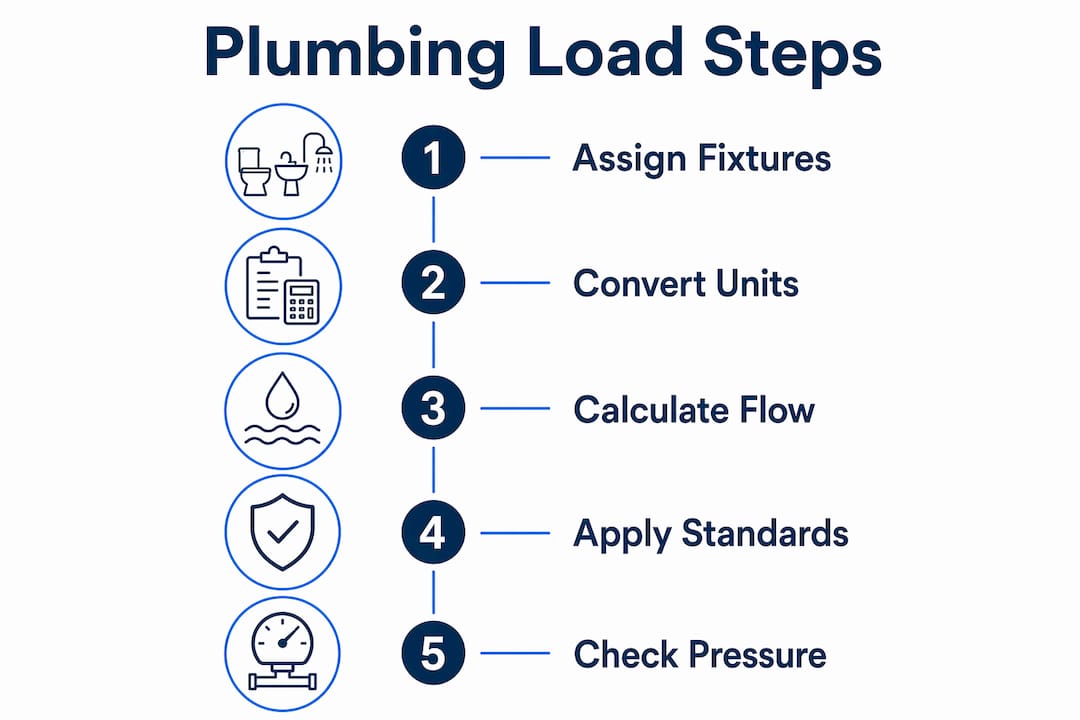
How do you perform plumbing load calculations step by step?
Plumbing load analysis follows a clear sequence. Skipping steps or estimating values introduces errors that compound through the entire design.
-
List every fixture in the building. Count toilets, sinks, showers, dishwashers, hose bibs, and any specialty fixtures. Commercial projects require separating public and private fixtures because their WSFU values differ.
-
Assign WSFU and DFU values. Use IPC or UPC fixture unit tables. Each fixture gets a supply-side WSFU value and a drainage-side DFU value. Record both columns separately.
-
Sum the total fixture units. Add all WSFU values for the supply system. Add all DFU values for the drainage system. Do this for the whole building and for each branch independently.
-
Convert WSFU to GPM using Hunter's Curve. Look up the total WSFU in IPC Table E103.3(3) to find the design flow rate. Interpolation between closest values is necessary when your total does not match a table entry exactly. This step is where most calculation errors occur.
-
Size hot and cold branches independently. Hot and cold supply must be sized separately; a fixture rated at 1.5 WSFU contributes that value to both branches. Do not combine them into a single calculation.
-
Apply the Hazen-Williams equation. Calculate friction loss for each pipe segment using the design flow rate and candidate pipe diameter. Select the diameter that keeps velocity within limits and friction loss within budget.
-
Build the pressure budget. Start with available street pressure. Subtract elevation loss, friction loss, meter loss, and fitting losses. Confirm residual pressure meets the minimum for every fixture, especially high-demand appliances.
-
Size drainage pipes using DFU totals. Match branch and stack DFU totals against IPC drainage tables. Confirm each segment stays within its rated capacity.
Pro Tip: Size the water heater supply line using the full hot water WSFU load, not just the fixtures closest to the heater. Undersizing the heater branch is one of the most common mistakes in residential remodels. Learn more about how tankless systems affect demand before finalizing your hot water branch size.
What are common pitfalls in plumbing load calculations?
Guessing pipe diameters is the single most damaging mistake in plumbing system design. Undersizing causes pressure drops and temperature swings. Oversizing wastes materials and creates stagnant water zones where bacteria can grow. Neither outcome is acceptable in a code-compliant system.
Common mistakes builders and contractors make:
- Sizing for peak simultaneous demand. Assuming every fixture runs at once produces oversized pipes that waste money and perform poorly. Probability-weighted fixture unit methods exist precisely to avoid this.
- Ignoring the venting system. Venting prevents pressure imbalances and sewer gas entry. A drain system sized correctly but vented poorly will gurgle, slow-drain, and eventually fail.
- Combining hot and cold loads. Each branch carries its own fixture unit load. Treating them as one calculation produces undersized hot water lines and inconsistent temperatures.
- Exact-matching code tables. Calculated WSFU totals rarely land on a table value exactly. Rounding up without interpolating can oversize the pipe. Rounding down can undersize it.
- Skipping ADA and code minimums. Commercial projects must meet fixture count minimums and ADA plumbing compliance requirements independent of load calculations.
"The plumbing system should be viewed as supply, drainage, and venting subsystems, each with distinct design considerations but working interdependently." — Plumbing Design Fundamentals for Architects and Engineers
Coordinating with mechanical and structural trades early prevents conflicts that force expensive pipe reroutes. A plumbing designer who waits until framing is complete often inherits routing problems that compromise pipe slope, velocity, and pressure budget simultaneously.
Key Takeaways
Accurate plumbing load calculations require fixture unit methods, probability-based flow conversion, and a verified pressure budget to produce a reliable, code-compliant system.
| Point | Details |
|---|---|
| WSFU drives supply sizing | Assign fixture unit values from IPC tables and convert totals to GPM using Hunter's Curve. |
| DFU governs drain capacity | 1 DFU equals 7.5 GPM of intermittent flow; match branch and stack totals to IPC drainage tables. |
| Size hot and cold separately | Each branch carries its own fixture unit load; combining them produces undersized hot water lines. |
| Interpolate, do not round | Calculated WSFU totals rarely match table values exactly; interpolate for accurate pipe sizing. |
| Verify the pressure budget | Subtract elevation, friction, and fitting losses from street pressure to confirm residual PSI at every fixture. |
What 15 years of plumbing work taught me about load calculations
Most builders treat plumbing load calculations as a paperwork step. They run the numbers, pick a pipe size, and move on. The problems show up two years later when a homeowner calls because their shower goes cold every time someone flushes a toilet three rooms away.
The real issue is almost always a hot water branch that was sized off the cold water calculation. It is an easy mistake to make, and it is completely avoidable. Sizing hot and cold independently adds maybe 30 minutes to the design process. Fixing the result after drywall is up costs thousands.
The other pattern I see constantly is ignoring the pressure budget on multi-story projects. Street pressure in Santa Maria and across Santa Barbara County varies more than most people expect. A system that works perfectly on the ground floor can starve the second-floor fixtures if nobody checked the elevation loss and friction loss math. That check takes 15 minutes with a basic friction chart. Skipping it is not a time-saver. It is a liability.
My honest recommendation: treat the pressure budget and the hot/cold branch sizing as non-negotiable steps, not optional refinements. And if you are working on a commercial project, get the fixture counts and ADA requirements confirmed before you touch a calculator. Changing fixture counts after the load calculation is done means starting over. Early coordination with architects and other trades is not a courtesy. It is how you avoid rework.
— Kirk
Drainpointplumbing can handle your plumbing system design needs
Getting plumbing load calculations right from the start protects your investment and keeps your system performing for decades. Drainpointplumbing brings over 15 years of residential and commercial plumbing experience to every project in Santa Maria and across Santa Barbara County.

Whether you need residential plumbing repairs and fixture installations sized to your home's actual demand or a full commercial system design, Drainpointplumbing delivers work grounded in IPC standards and real-world load analysis. The team handles everything from pipe sizing and fixture replacement to water heater selection and pressure testing. Request a free plumbing quote and get a professional assessment of your system's current capacity and design needs.
FAQ
What is a Water Supply Fixture Unit (WSFU)?
A WSFU is a dimensionless value assigned to a plumbing fixture based on its flow rate, usage duration, and probability of simultaneous use. It is the primary input for converting fixture demand into a design flow rate in GPM.
What does 1 DFU equal in actual flow?
One DFU equals approximately 7.5 gallons per minute of intermittent drain flow. IPC tables use DFU totals to determine the required diameter for horizontal branches and vertical stacks.
Why can't I just size pipes for peak simultaneous demand?
Sizing for peak simultaneous demand assumes every fixture runs at once, which never happens in practice. Probability-weighted fixture unit methods produce smaller, more cost-effective pipe sizes that still handle real-world peak loads.
How do I convert WSFU to GPM?
Use Hunter's Curve, codified in IPC Table E103.3(3). Look up your total WSFU value and read the corresponding design flow in GPM. Interpolate between table entries when your total falls between listed values.
What minimum residual pressure do fixtures need?
Most fixtures require at least 15–20 PSI of residual pressure. Tankless water heaters typically require 25–30 PSI. Always check the manufacturer's minimum before finalizing your pressure budget.