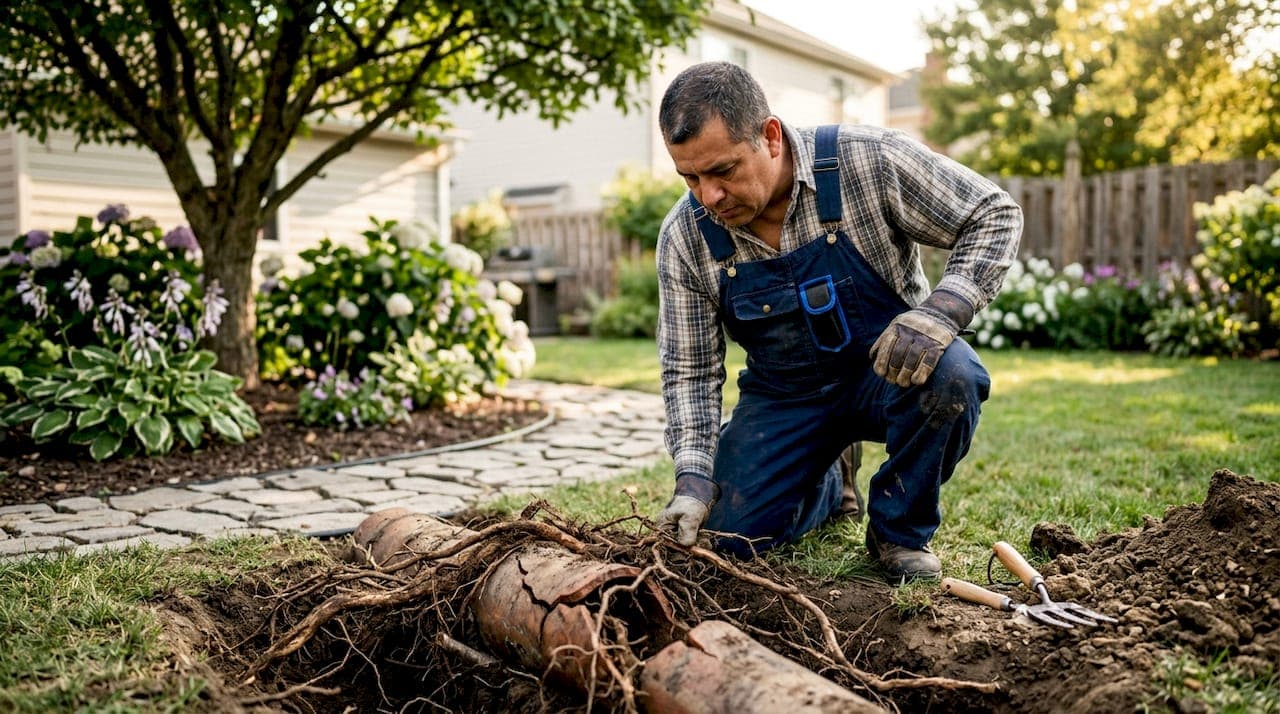
Tree root intrusion, the industry term for sewer line root invasion, is defined as the process by which plant roots exploit moisture, nutrients, and oxygen leaking from damaged or aging pipes. Roots do not break intact pipes. They follow vapor and moisture gradients to existing cracks, failed joints, and deteriorating seals, then grow aggressively once inside. Understanding why roots invade sewer lines helps you protect your property before a slow drain becomes a sewage backup and a costly repair bill.
Why do roots invade sewer lines?
Roots invade sewer lines because of a biological process called hydrotropism, the tendency of roots to grow toward moisture. Every sewer pipe carries warm, nutrient-rich water. When a joint fails or a crack forms, that moisture escapes as a vapor plume into the surrounding soil. Fine root hairs, sometimes thinner than a human hair, detect that gradient and grow directly toward the source.
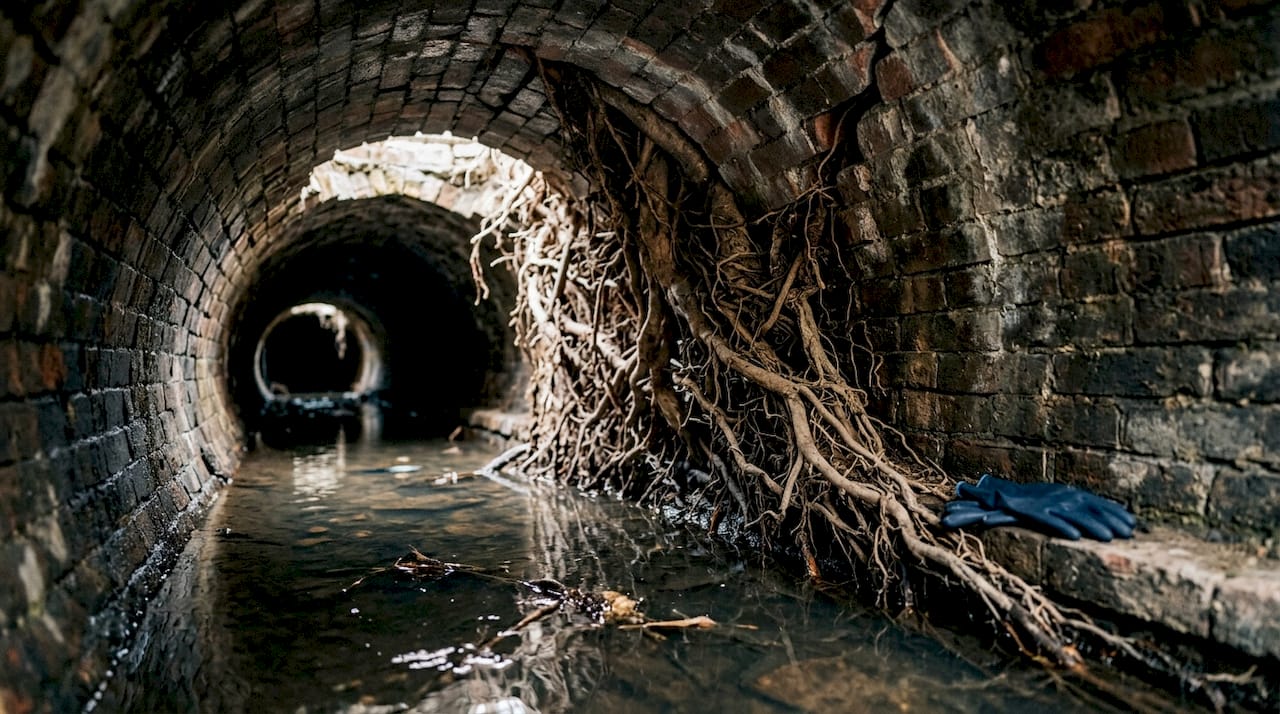
Roots grow toward moisture, nutrients, and oxygen leaking from pipe joints through hydrotropism. This is not random. It is a targeted biological response that makes sewer pipes one of the most attractive destinations for root systems in any yard.
The most common entry points are:
- Aged clay tile joints: Clay tile pipes were standard in homes built before the 1970s. Their bell-and-spigot joints shift with soil movement, creating gaps roots can enter.
- Orangeburg pipe: This fiber-based material, used from the 1940s through the 1970s, softens and deforms over time, producing cracks along its entire length.
- Cast iron corrosion: Cast iron corrodes from the inside out. Pinholes and joint failures appear decades after installation.
- PVC joint failures: Even modern PVC can develop leaks at poorly glued or shifted joints, especially in areas with expansive clay soils.
Older pipe materials like clay tile and Orangeburg are far more susceptible because they have more joints per linear foot and deteriorate faster. A 50-year-old clay tile lateral may have a joint every 3 feet, giving roots dozens of entry points between your house and the city main.
Pro Tip: Drought conditions push roots to search harder for water. During dry summers in Santa Barbara County, root intrusion risk rises sharply because trees under stress send roots deeper and farther in search of moisture.
How fast do roots grow inside a pipe?
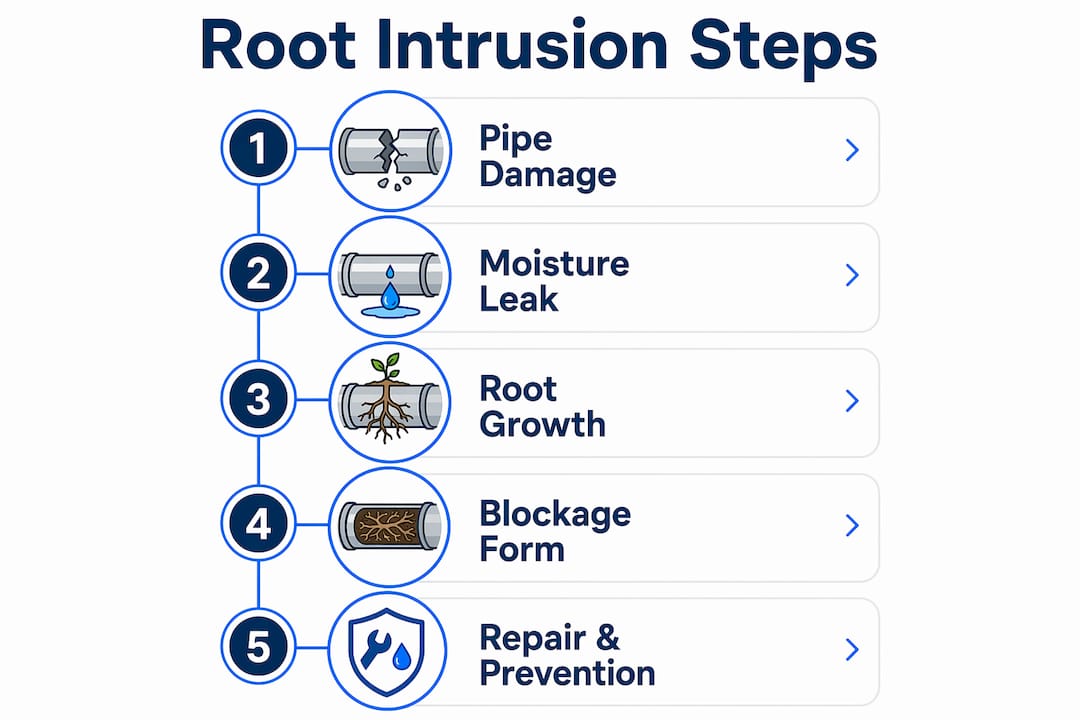
Root intrusion follows a predictable timeline that most homeowners never see until it is too late. A root hair enters through a hairline crack and finds the interior of the pipe to be an ideal growing environment. Warm moisture, dissolved nutrients, and oxygen are all present in abundance. Pipe interiors provide greenhouse-like conditions that accelerate root growth far beyond what the same root would achieve in open soil.
The progression typically looks like this:
- Year 1: Fine root hairs enter through a joint gap or crack. Flow is unaffected. No symptoms appear.
- Year 2: Root hairs branch into secondary roots. Toilet paper and debris begin catching on the growth. Slow drains may appear.
- Year 3: A fibrous mat forms inside the pipe. Grease, solids, and debris accumulate on the mat. Backups become more frequent.
- Years 4–5: The root mass expands to fill the pipe cross-section. Full blockages occur. Pipe walls face pressure from the root mass.
Root masses can fill an entire pipe cross-section within 3–5 years if left unmanaged. That timeline is fast enough to turn a minor joint leak into a sewage emergency within a single home ownership cycle.
Root intrusion also forms fibrous mats that trap debris and accelerate pipe deterioration. The mats act like a net, catching every piece of solid waste that passes through. Over time, the trapped material creates additional pressure on the pipe walls, speeding up the damage that allowed roots in to begin with.
Which tree species cause the most sewer problems?
Not all trees pose equal risk. Species with aggressive, fast-spreading root systems cause the most damage to sewer infrastructure. Silver maple, cottonwood, willow, American elm, and Siberian elm are among the most aggressive offenders.
Willows and cottonwoods are particularly problematic. Both species evolved near water sources and have root systems that extend two to three times the canopy width in search of moisture. A willow planted 20 feet from a sewer lateral is effectively planted on top of it. Silver maples grow fast and produce dense, shallow root networks that cover large areas of soil quickly.
American and Siberian elms are common street trees in older neighborhoods. Their roots follow utility corridors, including sewer lines, because the disturbed soil along those corridors is looser and easier to penetrate. If your property has mature elms along the street, your lateral is at elevated risk.
When choosing trees for your yard, distance from the sewer lateral matters as much as species selection. Understanding tree removal cost factors is worth knowing before you plant, because removing a mature problem tree later costs far more than choosing a slow-growing, non-invasive species at the start.
How can you prevent root intrusion in your sewer?
Prevention is more cost-effective than repair at every stage. The most reliable approach combines regular inspection, smart landscaping, and targeted chemical maintenance.
- Schedule camera inspections every 2–3 years. A sewer camera inspection catches early-stage root entry before any symptoms appear. This is the single most effective diagnostic tool available.
- Choose slow-growing trees. Crape myrtles, ornamental pears, and dwarf fruit trees have compact root systems that pose minimal risk to sewer lines.
- Plant at safe distances. Keep large trees at least 10 feet from any sewer lateral. Aggressive species like willows need 30 feet or more.
- Use chemical root killers as maintenance, not treatment. Chemical foaming root killers work too slowly to clear an active blockage. They are effective only after mechanical cleaning, as a follow-up treatment to slow regrowth.
- Upgrade old pipes. Replacing clay tile or Orangeburg laterals with PVC eliminates the joint failures that roots exploit. Fewer joints mean fewer entry points.
- Consider a preventive plumbing contract. Preventive plumbing contracts give you scheduled inspections and priority service, which keeps root intrusion from reaching the emergency stage.
Pro Tip: After mechanical root cutting, apply a foaming copper sulfate-based root killer within 48 hours. The freshly cut root ends absorb the chemical more effectively, slowing regrowth significantly.
Drought conditions worsen root intrusion by pushing trees to search more aggressively for water. In dry climates like Santa Barbara County, this makes annual maintenance especially important during and after drought years.
What are your repair options after root intrusion?
Once roots have entered a sewer line, you have several options ranging from temporary fixes to permanent solutions. The right choice depends on how far the intrusion has progressed and the condition of the pipe itself.
Mechanical snaking and root cutting is the most common first response. A rotating cutting head removes the root mass from inside the pipe. Mechanical snaking costs $100–$600, while pipe repairs or replacements start at $700. Snaking is fast and affordable, but it treats the symptom, not the cause.
Roots typically return within months to two years after mechanical cutting if the pipe joint failure is not addressed. That cycle of recurring cleanings adds up quickly and never resolves the underlying problem.
More permanent options include:
- Pipe relining (CIPP): A resin-saturated liner is inserted and cured inside the existing pipe, sealing all cracks and joints without excavation. This eliminates root entry points and extends pipe life by decades.
- Pipe bursting: The old pipe is fractured outward while a new pipe is pulled through. This replaces the pipe entirely with minimal digging.
- Open-cut replacement: For severely collapsed or deteriorated pipes, full excavation and replacement is the most thorough option.
Pipe joint failure and root intrusion are inseparable problems. Cutting roots without sealing the entry point guarantees the problem returns. Combining mechanical cleaning with pipe relining or replacement is the only approach that delivers lasting results. For property managers dealing with recurring issues, reviewing commercial drain failure case studies shows how quickly unmanaged root intrusion escalates into structural damage.
Key Takeaways
Root intrusion is a symptom of pipe deterioration, not aggressive root behavior, and the most effective response combines inspection, mechanical cleaning, and permanent joint repair.
| Point | Details |
|---|---|
| Roots follow moisture, not force | Roots enter pipes through existing cracks and joint failures, not by breaking sound pipes. |
| Intrusion progresses fast | Root masses can fill a pipe completely within 3–5 years without intervention. |
| Species selection matters | Willows, silver maples, and elms pose the highest risk near sewer laterals. |
| Cutting alone is temporary | Roots return within months to two years unless the pipe joint failure is also repaired. |
| Prevention beats repair | Camera inspections every 2–3 years catch intrusion before symptoms and costly damage appear. |
What 15 years of sewer calls taught me about root intrusion
Most homeowners I talk to assume the tree attacked their pipe. The reality is almost always the opposite. The pipe failed first, and the tree followed the leak. Root intrusion is fundamentally a symptom of aging infrastructure and ground movement, not aggressive root drilling.
The myth that roots are the villain leads homeowners to cut roots repeatedly without ever fixing the pipe. I have seen properties where the same lateral was snaked every 8 months for five years. Each time, the roots came back faster because the joint gap was getting larger. The real fix was a $2,400 reline, not another $300 cleaning.
The other thing most articles miss is that trees are opportunistic moisture seekers, not enemies. If your pipe were sealed and intact, the roots would pass right by it. The tree is doing exactly what biology designed it to do. Your job as a homeowner is to make sure the pipe does not give it an invitation.
My honest recommendation: get a camera inspection before you buy any property older than 20 years. The cost is minimal. What it reveals can save you from inheriting someone else's 4-year-old root problem that is one heavy rain away from backing up into your living room.
— Kirk
Drainpointplumbing can find and fix root intrusion fast
Root intrusion rarely announces itself until the damage is already significant. Drainpointplumbing uses professional-grade sewer camera inspections to locate root entry points, assess pipe condition, and recommend the right fix the first time.
Whether you need mechanical root cutting, a chemical follow-up treatment, or a full sewer line inspection and repair in Santa Maria or anywhere across Santa Barbara County, Drainpointplumbing has the equipment and 15 years of experience to handle it. For homeowners dealing with recurring slow drains or backups, a free plumbing quote is the fastest way to find out exactly what is happening inside your pipes. Available 24/7, with senior and military discounts.
FAQ
Why do roots grow into sewer pipes specifically?
Roots grow into sewer pipes because damaged or aging pipes leak warm moisture, nutrients, and oxygen into the surrounding soil. Hydrotropism drives roots directly toward that vapor plume and through any available crack or joint gap.
Can roots break a pipe that has no existing damage?
Roots rarely break intact pipes. They exploit existing joint failures and cracks rather than forcing their way through sound pipe walls.
How long does it take for roots to block a sewer line?
Root masses can fill an entire pipe cross-section within 3–5 years if left unmanaged, starting from an initial entry through a small crack or joint gap.
Are chemical root killers enough to solve the problem?
Chemical foaming root killers work too slowly to clear an active blockage. They are effective only as a post-cleaning maintenance treatment to slow regrowth after mechanical removal.
What is the most permanent fix for root intrusion?
Pipe relining, also called CIPP, seals all cracks and joint failures from the inside without excavation, eliminating root entry points and extending pipe life by decades.