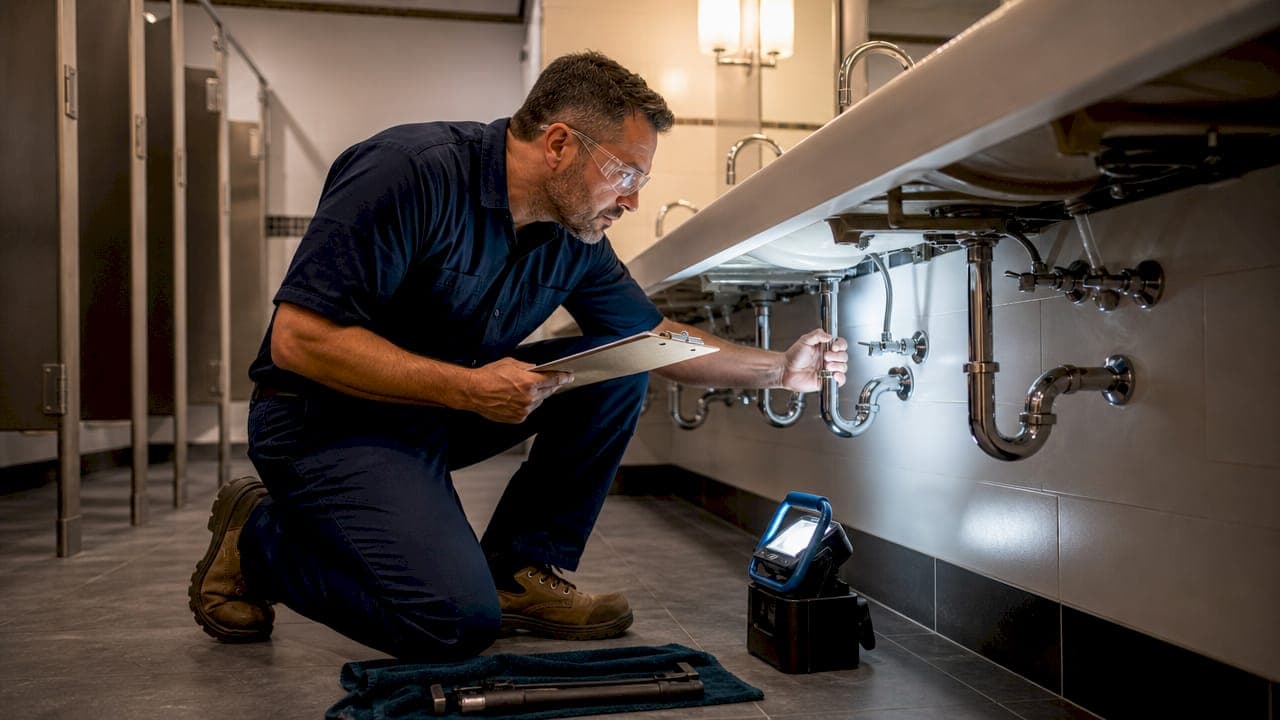
Commercial plumbing maintenance best practices are defined as the scheduled, documented, and compliance-driven activities that keep a building's water supply, drainage, and mechanical systems operating without failure. Property managers who treat plumbing upkeep as a risk mitigation strategy rather than a reactive fix consistently avoid the most expensive breakdowns. Regulatory standards in most jurisdictions require annual backflow preventer testing, biannual professional inspections, and documented service records for compliance-critical assets. Skipping these obligations exposes your property to water service shutoffs, failed audits, and voided insurance policies. The financial and safety case for preventive maintenance is not theoretical. It is the difference between controlled costs and a crisis.
1. Commercial plumbing maintenance best practices: routine inspection tasks
Professional inspections form the foundation of any sound maintenance program. Schedule inspections at least twice a year to catch early signs of corrosion, leaks, and pressure imbalances before they become structural problems. Properties with aging infrastructure or high occupancy need inspections more frequently than that baseline.
The core tasks that belong on every commercial plumbing maintenance checklist include:
- Leak detection: Check all visible supply lines, valve connections, and fixture fittings at each inspection cycle.
- Water pressure monitoring: Maintain pressure within the 60–80 psi range. Pressure outside that range accelerates pipe wear and increases fixture failure rates.
- Drain cleaning: Fixed-interval preventive drain cleaning prevents grease buildup that causes structural damage requiring costly excavation.
- Backflow preventer testing: Annual testing and certification submission to local water authorities is mandatory in most jurisdictions.
- Water heater servicing: Annual flushing, anode rod checks, and thermostat inspection prevent premature failures and maintain energy efficiency.
- Grease trap cleaning: Food service facilities require quarterly grease trap pump-outs to meet health code requirements.
Pro Tip: Schedule your biannual inspections in march and september. Those windows fall before summer peak demand and before winter temperature drops, giving you maximum lead time to address any issues found.
2. How to build a preventive maintenance checklist and documentation system

A written, fixed-interval inspection schedule is the single most effective tool a property manager can deploy. Customized inspection checklists and digital maintenance tracking give you a prioritization framework that reduces costs and extends infrastructure lifespan. Without a documented schedule, maintenance gaps accumulate silently until a failure forces your hand.
Build your documentation system in four steps:
- Create a compliance asset register. List every backflow prevention device, thermostatic mixing valve (TMV), and hot water system with its last service date and next-due date. Maintaining this register is the primary defense against legal exposure during audits.
- Assign fixed inspection intervals. Tie each asset to a specific frequency: annual for backflow devices, biannual for general inspections, quarterly for grease traps and high-traffic drains.
- Switch to a CMMS platform. Manual paper logs create maintenance interval gaps that increase liability exposure during regulatory reviews. A computerized maintenance management system (CMMS) eliminates those gaps automatically.
- Archive service certificates. Store compliance certificates, inspection reports, and technician sign-offs in a single location accessible to your insurance provider and local authority on demand.
Pro Tip: Ask your licensed plumber to generate a compliance certificate at every service visit. That document is your proof of due diligence if an insurer or regulator ever questions your maintenance history.
3. Compliance requirements and the real risks of neglect
Regulatory compliance is not optional for commercial plumbing systems. Local water authorities mandate annual backflow device testing and require documentation submitted on a fixed schedule. Failing to test backflow prevention devices annually can result in mandatory water service shutoff and regulatory penalties. That outcome alone can halt business operations for days.
The consequences of non-compliance extend well beyond a fine:
- Failed audits trigger mandatory remediation timelines and additional inspection fees.
- Infringement notices go on record and affect future permit applications.
- Voided insurance policies leave you personally liable for water damage claims.
- Legal exposure increases sharply in food service and healthcare environments where water contamination risks carry public health implications.
"Non-compliance consequences such as failed audits and voided insurance policies are real and significant, not only theoretical risks." — Commercial Building Plumbing Maintenance Compliance Guide
Only a licensed plumber can generate the compliance documentation that satisfies local authority requirements. Relying on unlicensed contractors for compliance-critical work is one of the fastest ways to void your coverage. Understanding how plumbing affects ADA compliance in commercial buildings adds another layer of regulatory obligation that property managers must track alongside standard plumbing maintenance.
4. Special considerations for high-traffic facilities and aging infrastructure
High-occupancy buildings and commercial kitchens operate under conditions that accelerate wear on every plumbing component. Busy restrooms, commercial dishwashers, and food prep sinks push drain systems past the limits that standard maintenance frequencies were designed for. Adjusting your schedule to match actual usage is not optional in these environments.
| Facility Type | Component | Recommended Frequency |
|---|---|---|
| Commercial kitchen | Grease trap pump-out | Quarterly or more frequent |
| High-traffic restroom | Drain cleaning | Quarterly |
| Any commercial building | Professional inspection | Twice yearly minimum |
| Aging infrastructure | Water supply line pressure test | Every 2–3 years |
| Any commercial building | Water heater evaluation | Every 2–3 years |
Aging pipe systems require a separate assessment track. Water heater replacement evaluations are recommended every 2–3 years for systems showing signs of sediment buildup or inconsistent output. Older galvanized or cast iron supply lines need pressure testing on the same cycle to identify corrosion before it causes a burst. Commercial repiping is a significant investment, but it costs far less than the water damage and business interruption that a failed line produces.
Pro Tip: For commercial kitchens, track grease trap pump-out volumes over time. A sudden increase in volume between service visits signals a change in kitchen output or a drainage problem upstream.
5. Using technology and professional partnerships to stay ahead
Technology changes what is possible in commercial plumbing system upkeep. A CMMS platform does more than store records. It sends automated reminders before due dates, generates audit-ready reports on demand, and flags overdue tasks before they become compliance violations. Centralized digital maintenance management tools are now considered essential for rigorous compliance and liability management in commercial properties.
Video camera inspections represent the most significant advance in identifying hidden pipe defects early. A licensed plumber can run a camera through your sewer lines and drain stacks to locate cracks, root intrusion, and offset joints without opening walls or excavating floors. That information lets you schedule repairs on your timeline rather than responding to a backup at the worst possible moment.
Building a vendor relationship with a single licensed plumbing contractor also produces measurable benefits. Priority scheduling, consistent service quality, and a technician who knows your building's history all reduce the time and cost of every service call. The contractor who serviced your backflow devices last year already knows where they are, what condition they were in, and what to watch for this year.
Key takeaways
Preventive commercial plumbing maintenance, backed by documented schedules and licensed professional service, is the most cost-effective way to protect a commercial property from operational disruption and regulatory liability.
| Point | Details |
|---|---|
| Inspect twice yearly at minimum | Professional inspections every six months catch corrosion, leaks, and pressure issues before they escalate. |
| Test backflow devices annually | Annual testing and certification submission to local water authorities is a legal requirement in most jurisdictions. |
| Use a CMMS for documentation | Digital tracking eliminates manual log gaps and produces audit-ready compliance records on demand. |
| Adjust frequency for high-traffic use | Commercial kitchens and busy restrooms need quarterly drain cleaning and grease trap pump-outs. |
| Evaluate aging systems every 2–3 years | Water heaters and older supply lines need pressure testing and replacement assessments on a fixed cycle. |
What 15 years of commercial plumbing work taught me about prevention
Most property managers I talk to come to preventive maintenance after a crisis, not before one. A burst supply line on a friday afternoon, a grease trap backup during a dinner service, a failed audit that triggers a water shutoff notice. Those events are expensive and avoidable. They share a common cause: the maintenance program was reactive, not scheduled.
The property managers who avoid those situations treat their plumbing asset register the same way a CFO treats a balance sheet. Every asset has a known condition, a service history, and a next-due date. Nothing is tracked from memory. When a regulator or insurer asks for documentation, the answer is ready in minutes, not days.
The part that surprises most people is how much the documentation itself reduces costs. When you can show an insurer a clean service history, claims move faster and coverage disputes shrink. When you can show a regulator a current compliance certificate, inspections end quickly. The records are not just paperwork. They are financial protection.
My honest advice: if you are still using a spreadsheet or a paper log to track your plumbing maintenance, you are one missed entry away from a compliance gap that costs far more than the CMMS subscription you avoided. The technology is not complicated. The risk of skipping it is.
— Kirk
Drainpointplumbing: professional commercial plumbing support in Santa Maria
Drainpointplumbing has served commercial property managers across Santa Barbara County for over 15 years, handling everything from routine inspections to full system overhauls.
Whether you need a sewer camera inspection to assess hidden pipe conditions, a water heater repair or replacement to keep your system compliant, or 24/7 emergency plumbing services when something fails outside business hours, Drainpointplumbing delivers licensed, documented work that satisfies local authority requirements. The team generates compliance certificates at every service visit and maintains service records that hold up under audit. Contact Drainpointplumbing for a free quote and a maintenance plan built around your property's specific needs.
FAQ
How often should commercial plumbing be inspected?
Commercial plumbing systems require professional inspection at least twice a year. Properties with aging infrastructure or high occupancy may need quarterly inspections for specific components like drains and grease traps.
What happens if backflow prevention devices are not tested annually?
Failing to test backflow devices annually can result in mandatory water service shutoff, regulatory penalties, and voided insurance coverage. Testing documentation must be submitted to local water authorities to maintain compliance.
What is a CMMS and why does it matter for plumbing maintenance?
A CMMS is a computerized maintenance management system that schedules tasks, sends reminders, and generates audit-ready compliance records. It eliminates the manual log gaps that create liability exposure during regulatory reviews.
How do I maintain plumbing in a commercial kitchen?
Commercial kitchens require quarterly grease trap pump-outs, fixed-interval drain cleaning, and annual water heater servicing. High-volume operations may need grease trap service more frequently than quarterly to meet health code requirements.
When should aging commercial pipes be replaced?
Older water supply lines should be pressure tested every 2–3 years to assess corrosion levels. If testing reveals significant deterioration, commercial repiping is the most cost-effective long-term solution compared to repeated emergency repairs.